
And now for something a little different. This Feature’s going to be odd. Fortunately, it’ll be short. Unfortunately, it’ll be dense. Though it’ll probably make the assholes who complain I never back up my claims with sources happy.
It’s also going to be the start of a casual, three-part argument about the nature of tabletop roleplaying game adventure and challenge design. It’ll bring together a lot of things I’ve mentioned in passing. We’re going to talk about creative problem solving, dice-rolling as gameplay, and ultimately, how to properly lock a door in a dungeon.
I ain’t going to explain the actual argument, though, or how this all got started. Not until the last part. Instead, I want to talk about open-ended, creative problem solving.
Riddle Me This…
Here’s a candle. Here’s a box of tacks. Attach the candle to the wall so wax can’t drip on my nice carpet. If you succeed, I’ll give you the Orb of Macguffin that you need to win the adventure. If you can’t solve it in time, though, my pet sphinx will eat you.
This Is Your Brain on Functional Fixedness
Did you solve the problem? I don’t actually care. That isn’t even my puzzle. It was actually presented by psychologist Karl Duncker in his 1945 book, On Problem Solving. Others have written about it since then, including Malcolm Gladwell, and a lot has been made about how few people can find a solution to the problem, but Duncker’s point wasn’t about the low success rate, and neither is mine.
His point was that presentation is everything. Kind of.
First, let me give you the most common and commonly accepted correct solution: pour the tacks out of the box, tack the box to the wall like a tray, then set the candle in it. Easy peasy.
Except it’s not easy. Some have found success rates as low as 5%, though it’s probably closer to 20%, and the way I presented it made it particularly difficult. I think. I haven’t run the numbers.
Let me explain…
When Duncker presented his version of The Candle Problem, he used visual aids. He gave participants pictures of the available accouterment with which to solve the scenario. Duncker discovered that one change to the visual aids hugely affected the success rate. If he showed people a picture of a box full of tacks, most people couldn’t solve it. If he showed people a picture with the tacks on the table next to the box, suddenly lots more people could solve it.
Like this…
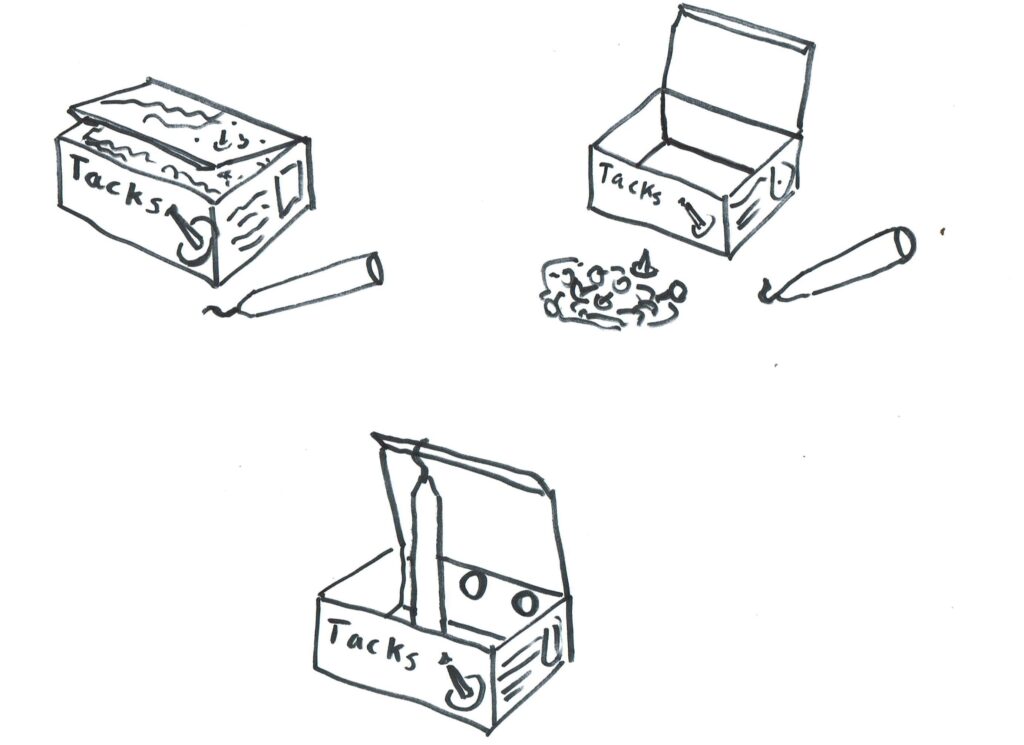
Now, Duncker wasn’t great about publishing his actual stats, but lots of people have done the experiment and similar experiments since then, and the results have been consistent with Duncker’s findings even if actual success rates are a little tough to pin down.
The most interesting version, to me, as a Game Master, because this does have to do with Game Mastering, I swear, is the one conducted at Stanford in 2003 by cognitive scientists Michael C. Frank and Michael Ramscar. They did it without visual aids. They did it narratively. They did it how I did it above. They found that only around 20% of people can solve it with normal, natural wording, but with slight tweaks to the wording, they could more than double the success rate. The difference between saying “a box of tacks” and “a small box filled with tacks” was dramatic.
Now Duncker and others were trying to demonstrate something called functional fixedness. It’s this prewired tendency in the human brain to see things in terms of their function or use to such a degree that you can’t see them as anything else. In The Candle Problem, to most people, the box is just a superfluous container. It holds the tacks. It’s not even part of the puzzle, really. If you separate the tacks from the box for people, suddenly, they can see the box as more than just a container.
Now, I find this shit cool. As a Game Master who wants to give every player the best narrative and gameplay experiences possible, I find everything to do with cognitive science fascinating, and especially anything about problem solving, decision making, and group behavior. I want to know how human brains work because I make games for human brains and because I don’t just want to make naked, screaming assertions based on anecdotal experiences.
Yeah, I know, I’m weird like that.
Anyway…
Functional fixedness is an interesting thing to know about, but there’s more to the story, because The Candle Problem is part of a broader class of open-ended problems in cognitive science.
The Problem Of Insight
Duncker’s candle thing is an example of what are called insight problems. They’re open-ended problems that can’t be solved with normal, step-by-step reasoning or problem-solving skills. Instead, finding a solution requires a sudden reframing of the situation in the solver’s head.
I’ve mentioned The Nine Dots Problem before. It’s another example of an insight problem. Take three rows of three equally spaced dots and try to connect them by drawing just four straight lines. The most common solution requires you to draw outside the dots.
Here…
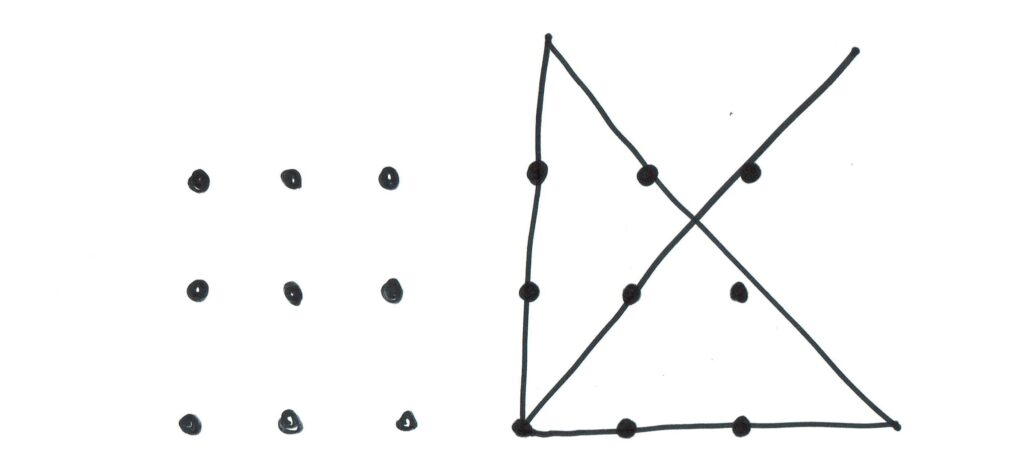
Most people struggle to solve the problem because their brains get stuck following an unstated rule that the lines can’t go outside the bounds established by the dots. Such problems are thus called constraint-relaxation problems. The solution requires you to recognize that you’re following a constraint that doesn’t exist.
There are all sorts of insight problems. In addition to functional-fixedness problems and constraint-relaxation problems, there’s representational change problems, lateral thinking problems, and lots of others. I ain’t going to do a whole survey. It’s a subject you can have all sorts of fun researching for yourself.
The important point is that, as Game Masters, most of what we think of as open-ended or creative or outside the box type problems are actually insight problems. For example, if the players recognize they can use a display pedestal as a battering ram to break down a door, they’ve just solved an functional-fixedness type of insight problem.
The other important point is that insight problems aren’t about information gathering, intelligence, reasoning, or creativity. They’re really just about getting lucky enough to break your own brain.
I shit you not.
Your Brain Is Always Overclocked
Let’s talk about someone else way smarter than me. Let’s talk about Daniel Kahneman, who basically invented the entire field of modern decision-making and problem-solving psychology. Kind of. I’m being hyperbolic, but the dude was a genius. He wrote a lot of very dense books about how brains solve problems and make decisions. Want some good, dense, summer reading? Check out Thinking Fast and Slow.
The big takeaway from Kahneman for today’s purposes is that your brain just really can’t handle anything you ask it to. It’s got too much sensory information coming in, too many concepts and associations stored inside of it, and a body that is way too complicated to actually operate. So it’s constantly looking for ways to limit the data it has to work with.
The reason most people struggle with The Nine Dots Problem is that the human brain imposes constraints just to limit the number of possibilities it has to consider down to a manageable number. The Candle Problem is hard because your brain simplifies things by boiling them down to function and utility whenever possible, or else it’ll just overheat from data processing.
In cognitive science, these necessary limitations are called heuristics and biases. They’re shortcuts and assumptions and constraints and limitations your brain imposes so that you can actually solve problems in anything approaching a reasonable time frame. What we call outside the box thinking is just your brain cutting through a mental shortcut. That’s why insight problems are usually very easy to solve once you overcome one particular cognitive hurdle.
But that also makes them kind of unfair tests of anything.
This Ain’t an IQ Test
Insight problems aren’t actually solved through reason, creativity, experiment, or effort. They’re not solved by anything we normally associate with intellectual problem-solving. Instead, everything is down to the solver’s initial understanding of the problem or a sudden, insightful shift in that understanding. Thus, people either solve them instantly or else sit there completely blocked until suddenly, they have a solution. It’s the mental equivalent of one of those 3D Magic Eye pictures snapping into clarity.
Insight problems aren’t good tests of intelligence, reason, or creativity. They actually measure how strongly a particular mental heuristic or bias is wired into the solver’s brain and how often they’ve broken it in the past. Personal experience is actually a key component.
But Duncker, the two Michaels, and many others demonstrated another vital component.
Presentation.
Narrative Problems are Problematic
Duncker demonstrated that you can hugely, drastically change The Candle Problem’s solve rate just by taking the tacks out of the box. Mike Frank and Mike Ramscar showed that tiny differences in word choice can double the success rate from one-in-five to even odds. As a Game Master, that shit actually bothers me a lot. It should bother you too.
See, as a Game Master, most of what I do is narration. Sure, I’ll draw an occasional diagram or present a visual aid for clarity, but my games are mostly just talky-talky. That’s how tabletop roleplaying games be. So it’s kind of a big deal that some problems become a lot harder to solve in talky-talky form. But it’s even worse when a tiny change in wording can take a problem from easily solvable to impossible.
That’s notwithstanding the fact that insight problems seem to have very low general success rates even when they’re presented perfectly with wording that befits a cognitive behavioral lab. If I’m looking at coin-toss level odds of any given player finding any solution to an entire class of open-ended problems instead of sitting there blocked, that ain’t great. Especially given that these things aren’t actually testing reasoning, creativity, experimentation, or effort but rather just lucky flashes of brain-breakage.
Scientifically, I’m not sure I can call “maybe the players will think to use a statue as a battering ram,” a fair problem-solving, gameplay challenge anymore.
Of course, if the probability that any given player will find a solution to an insight problem is 50%, then a group of four or five such players has a 90% chance of coming up with something. Even if the odds of one player finding any solution are 20%, that means a party has over a 60% chance of coming up with something. That’s just basic math, right?
Here’s the problem with that argument. The two problems. First, we’re really talking about coin tosses here. Psychologically, insight problems really are a toss of the die. They’re not skill-based or intelligence-based. They’re not testing what Game Masters think they’re testing.
But second, teams can make insight problems harder.
Teamwork Don’t Make This Dream Work
By their very nature, insight problems don’t make great group problem-solving activities. They’re not in the same class as things like mysteries that hang on deductive, inductive, or abductive reasoning. When you’re doing inferential reasoning, you can make incremental progress by reasoning. Organizing facts, identifying relationships, brainstorming explanations, looking for contradictions, and testing hypotheses all advance you to a successful solution. So, they’re things groups can effectively talk through. But insight problems aren’t advanced by reason. The only thing groups can do is say, “We could try this,” and, “That won’t work” over and over. Without the useful, creative eureka that makes the solution trivial, there’s nowhere to go but blocked.
Now, even if that’s true, which it is, because I only say true things, more people pulling their mental slot machine levers over and over hoping for a jackpot does increase the odds of success. But that’s only if the group doesn’t talk.
What keeps people from easily solving open-ended, insight problems, though, is that they’re basically mental traps. They’re problems because our brains are trapped by their own wiring, and the solution arises if you get lucky enough for your brain to rip itself free. But mental traps are easily reinforced. Your brain likes being trapped. It needs to be trapped to function. All it takes is one dumbass saying the wrong thing to reinforce everyone’s mental biases, and then no one’s breaking free.
It’s like this…
If the group starts talking through The Candle Problem and everyone keeps talking about just the tacks and the candle and no one says, “box of tacks,” gradually the box gets forgotten completely. It gets edited out of everyone’s memory. Worse yet, if some dumbass says aloud, “All we’ve got is tacks and a candle; how are we supposed to work with that?” then everyone gets kicked away from that vital eureka moment.
A group trying to solve an insight problem is equally likely to dig all its brains deeper into whatever mental trap it’s in as to help each other escape based purely on careless talk.
Which is the real problem…
Insight Problems Aren’t Hard; They’re Brittle
I hope it’s totally obvious at this point that I’m not just talking about solving The Candle Problem or talking just about overcoming mental constraints. I’m talking about an entire class of open-ended, creative problem-solving challenges that Game Masters love to throw at their players. In the past, I’ve called them open-ended creativity challenges. That’s what happens when the Game Master throws an obstacle in front of the players and trusts the players’ abilities to creative their way around them using whatever they have in their packs or repurposing whatever random stuff is scattered about the environment. Washed-out bridges over rivers, blocked doors with no lock or key, spike-filled pits dividing the room, shit like that.
Almost every “I don’t design puzzles; I don’t design games; I design situations,” ends up at an insight problem, but without the careful design of a cognitive behavioral experiment. They’re a hallmark of “old school” play, especially, and often touted as “emphasizing player skill over what’s on the character sheet,” but scientifically speaking, that’s a load of crap.
I have nothing against letting players creative their way around anything. I would never stop my players from building a raft out of fallen trees. I wouldn’t stop them from crossing a pit with some rope, a ladder, and some pitons. If my players use a statue as a battering ram, that’s awesome. This crap is what makes tabletop roleplaying games so great. It’s also why you can’t have a real tabletop roleplaying game without a real, human brain running the show. The Game Master’s job is to adjudicate the players’ every creative action. Decide whether their plans can succeed, whether they can fail, and find a way to determine the outcome.
But knowing what I do about game design, cognitive science, and the psychology of problem solving, I also can’t call an insight problem a fair gameplay challenge. Not because they’re too hard, not because of the odds, but because they’re not really fair and reliable tests of the players’ mental skills.
It ain’t that it’s hard to come up with an outside-the-box solution to The Washed-Out Bridge Problem, but, rather, first, that it’s not really a group-oriented reasoning challenge, and, second, that it’s extremely brittle.
What do I mean by brittle? I mean the challenge is easily wrecked by things outside mine and my players’ control. If I say the wrong word when I present the problem, I can cut the players’ odds of finding a solution in half. That ain’t a fair test of my players’ mental skills. If my word choice or hasty diagram glosses over an important affordance, I can make the problem completely impossible for normal human brains to solve. That’s a huge problem if I don’t even know what affordances are and how I can accidentally gloss over them. If one dumbass player unwittingly makes the wrong comment while talking out the problem, they might make the game unwinnable.
Imagine there’s a board game that has a very finicky setup, and if one piece is set up even the tiniest bit out of place, the red player can never win, and that’s not even mentioned in the rule book. Is that a fair game? No. You can get a fair game out of it, but the tiniest mistake makes it unfair and unplayable.
That’s brittle.
Insight problems are brittle. They’re too sensitive to build your core gameplay around. They belong in the game. Or, rather, insight solutions belong in the game and the mere presence of the Game Master makes them possible, but if you want to design actual, good, fun, fair gameplay challenges — if you, like me, believe anyone sitting at the table deserves the best narrative and gameplay experience you can deliver — insight challenges can’t be all you do. They can’t even be most of what you do.
And now that I’ve proven my point scientifically and shown my work, I’m sure I’ll be rolling in apologies by the time I get back from my trip, and no one will ever fight with me again about this.
But how can you incorporate open-ended creative insight-based gameplay in a tabletop roleplaying game? Because that really is good stuff; it’s just not load-bearing gameplay. Well, I’ll tell you. Eventually. But first, we have to talk about the other gameplay extreme, which, ironically, turns out to be the same thing and, ironically, can be solved exactly the same way.
So, stay tuned…
That’s a good article and brittleness is a fun concept. Just the attack on “old school” play seems to be a category error. Of course, if you expect such an insight problem between the players and the adventure, then that sucks, no argument. I just don’t think that’s typical for what OSP is going for. I would much rather expect several interesting paths, different kinds of fun to pursue, and thus less of a problem if one is a dead end (i.e. no creativity for that day). This inherently inhibits stuff like arcs and maybe pacing, but can lead to cool emergent stories. So I’m not saying there is nothing to criticize here, but I don’t think it’s these challenges.
Really good food for thought. Though you failed to mention the ten foot pole in the candle challenge 🙂
I think my experience is pretty illustrative of just how brittle these sorts of problems can be. My first thought was “you can’t stick a tack in a wall securely enough to support a candle”, my second thought was “I bet you’re supposed to assume that you can stick tacks in a wall securely enough to support a candle”, my third thought was “this isn’t problem solving, it’s guessing how someone else thinks the world works. I’m just going to skip to the answer”, and my fourth thought was “yeah, that wouldn’t actually work”. But how was the problem designer to know that I spent my childhood playing with tacks and candles and sticking things into walls?
My thought was melt the candle to the wall and tack the box below it to catch wax but not support weight
Ha ha, my first thought was, “what’s the box made of”, as I’d assumed it was plastic. Once I thought some more and realised it was an olden times puzzle, I worked out the box was cardboard or such. Point being, the puzzle isn’t fully self explanatory, you need to investigate to get the context.
Ps. in our game tonight, we got three puzzles to solve (yeah, I know…). I messed up the third, by instantly making a (reflex) joke answer. As soon as I said it, I wished I could take it back – it really did halve the team’s chances of success. We failed,
Right, even the proposed “correct” solution is still heavily abstracted, and wouldn’t actually work in reality, at least not without presenting a huge fire hazard, there’s no universally agreed upon model of what constitutes a candle, there are tall ones and thick ones. The candle presented in the image would be more like a birthday candle or a candle stump, it’s much smaller than what is conventionally thought of as a regular candle (barring limited experiences and biases).
A box of that nature is usually made out of woodpulp or paperboard, it wouldn’t be able to support the weight of just about any but the smallest of candles, and even then affixing and balancing such a small candle safely would likely involve some major origami skills, especially since candles of that make generally don’t have flat bottoms, they’re convex, so shouldn’t be expected to stand on their own. But of course the box could also plausibly be made out of plastic, so the variables involved can drastically change the available solutions, and yet the variables are just glossed over in the written/spoken example.
So if you say just the word candle to five people, you might end up with five widely different impressions, and that’s just a single component of the problem.
My first thought was to wrap the wick around a tack shift and pin the candle to the wall by that. Sure, now it’s unusable, but it that just means it won’t drip – and it’s not like the problem said it had to be usable.
Here’s how my dumb pedantic brain interpreted this:
Task: ‘Attach the candle to the wall so wax can’t drip on my nice carpet.’
Solution: ‘..tack the box to the wall like a tray, then set the candle in it.’
Pedantic Brain: Tacking the box to the wall is not attaching the candle to the wall. Even resting the candle on the tacks pushed into the wall is cheating!
Anyway. I loved this article! This is the one that finally prompted me to support your work.
This whole thing has always bugged me. I’m on the edge of my seat to hear more of your thoughts on it!
In the first campaign I ran, I had two instances of this, one of which I think I handled well, the other much less so.
In the latter, for load-bearing narrative reasons, the PCs had to out-hunt Herne the Hunter. Problem: their hunting skills were abysmal. They did have tons of magic, however, and I figured they would use that to cheat … but the players took *forever* to hit the eureka moment, and almost lost the challenge. I would entirely believe my own presentation was partly to blame for that, locking them into the assumption that they had to go at it straight.
The successful one was player-driven. One PC had a flaw where her soul was outside her body, in a ring she owned. Another PC wanted to fix this flaw. There was *nothing* in the mechanics to cover this, so I basically said, okay, pitch me your best metaphysical b.s. The first proposal was sensible and tame and unconvincing; the second was much more appropriately gonzo. Since it was player-driven, nothing would break if they failed to do it, and the system was friendly to off-brand uses of magic, the open-endedness of felt just fine.
Useful reflections and food for thought in future games . . .
The successful one was player driven…. I would bet this is a big factor. Looking forward to more on this.
Regarding brittleness, if players are actively forming plans using misunderstood narration, it would be very reasonable for the GM to step in and clarify or restate the information in the manner the characters received it.
Regarding team work, some parties will absolutely suffer from group think – players forgoing critical thinking to maintain harmony or just to go along with whoever the loudest decision maker is.
The problem is that restating it to correct a misunderstanding of the narration is essentially giving them the answer. When Player says, “All we have are some tacks and a candle,” correcting that means mentioning the box which calls attention to it. And once the box is called to attention, the solution becomes obvious.
I have done that in the past, but I only use puzzles or challenges like this (didn’t have a name for them; thanks Angry!) as little teasers that are largely incidental or trivial so that if they don’t get it fairly quickly it doesn’t break anything to give them the answer (which seems always preferable to having them beat their heads in frustration).
This article is making me think quite hard about the design choices of games like Mythic Bastionland, where each of the adventure hooks doesn’t include a solution.
It will make me think if the insight problems provided by the game are fun to solve or not. I’m also curious if the unbounded timeframe and ongoing escalation means coming up with solution ideas for them is more enjoyable for the players.
Excited to play more adventures designed this way to consider each way. I always thought having players need to invent solutions would be more fun than thinking of the right one, but no longer sure.
Based on your description, I understand insight problems as generally having a single specific solution in mind, with part of that solution going against the usual heuristics your brain will use, which makes them impossible to solve until you somehow realize that the heuristic you’re using is wrong.
Whereas if I read the sentence “I don’t design puzzles; I don’t design games; I design situations,”, I’m imagining a problem with many different possible solutions, or even many different possible categories of solutions. In the case of the washed out bridge over the river, for example, “try to cross here” and “travel up/down river looking for a place to cross” are (a non-exhaustive list of) broad categories of solutions, each of which then further divide into multiple subcategories. For “try to cross here”, some of those subcategories would be: “build something”, “get one party member across who helps the rest”, or “we’ll get wet during the crossing, then dry ourselves up afterwards”.
Now, it is true that some of those categories require a reframing of the problem. “Travel around” only becomes a solution when someone realizes that the group doesn’t necessarily have to cross here, and “we’ll get wet” requires getting rid of the unstated rule that you have to remain dry. But it is also true that even if the players were to somehow limit the problem to “the bridge is washed out, so we have to build a replacement bridge” you still have multiple solutions available: use carpentry skills for a wooden bridge, somehow get two ropes across to build a rope bridge, find big rocks to place in the river to use as stepping stones.
If there are generally multiple solutions available within the likely constraints the players brains will come up with, and multiple more depending on which heuristic they realize they can get rid of, then I don’t see how such an open ended creativity challenge would have the problems related to a challenge which requires finding a single specific solution that breaks a mental heuristic.
Insight problems do not have a single, specific solution. They can have “a” solution someone designed, but they don’t have to and often don’t.
That is why I used the phrase, “most common, commonly accepted solutions.” What you are describing ARE insight problems.
Superb shot of info, which I absolutely will not be referencing in my professional life in adult education.
Because this blog is specifically about pretend-elves only and definitely has no real-world application at all…
Thank you, and looking forward to the next couple of instalments!
Thank you for this, this really explains to me why I have started to gravitate back towards traditional games rather than more narrative games.
It reminds me of the old adage of strategy and tactics. Or perhaps in different lingos, insight and game, and narrative and mechanics.
(Essentially, figure out how to defeat a rubber creature when your best attacks are lightning vs typical wargame / board game that is fun to play.)
I used “and” rather than “versus” because all games (even the narrative ones) have both mechanics and insight to them, but the narrative ones try to dwell more in insight and narrative and strategy while traditional games focus more on game and mechanics and tactics.
While I like more narrative games, I have found them hollow after awhile.
“And now that I’ve proven my point scientifically” that’s fun )
I was going to pull back the carpet from the wall and tack it away from the dripping wax.
Daring today, aren’t we?