
There’s just too much ground to cover for me to waste time on one of my trademark Long, Rambling Introductions™.
Last time, I introduced the Tension Clock system to help you track time at your physical or virtual game table. The Tension Clock system does more than that, but don’t worry about it. Just trust me. It’s a good system.
Today, I want to show you what it looks like to actually use my Tension Clock system and take you through some specific practices and procedures.
How to Actually Use Tension Clocks
So Tension Clocks are just these visual aids you display on your physical or virtual table, right? Each represents a specific period of time, and each is divided into six appropriately- but vaguely-sized segments. There’s an Hourly Clock, which I also call a Delve Clock, that breaks an approximate hour into six several-minute segments, and there’s a Daily Clock, which breaks a game day into six few-hour segments. Each segment is called a Watch, has a name, and specifies how bright that part of the day is: Daylight, Twilight, and Darkness.
Incidentally, if you didn’t like those basic-ass Tension Clocks I shared last week, I made a set of really nicely designed ones, including seasonal Daily Clocks with different amounts of daylight and darkness, mostly for personal use. I gave them away for free to the folks who support this site at the Angrican and Frienemy Tiers. You can get access by supporting the site, or you can just buy them for a few bucks on Patreon.
If you’re a supporter and you missed them or just want to buy them, check out the post on Patreon.
You use six-sided dice, called Tension Dice, even though they’re just normal dice, or tokens to track the passage of time on the Tension Clock. Whenever the designated several-minute or few-hour interval has passed, usually because your players took a Time-Consuming action, put a die on that segment of the Tension Clock. When the Tension Clock is full, grab all the dice, Check for a Complication, then start with the fresh, empty Tension Clock.
If, at any point, the players take a Risky Action, grab whatever Tension Dice are currently on the Tension Clock, Check for a Complication, then put the Tension Dice back. If there are no Tension Dice on the Tension Clock, just roll one Tension Die.
To Check for a Complication, roll the Tension Dice and see if any are showing a 1. If even one Tension Die landed on a 1, a Complication is coming. Always Check for Complications behind the screen. Don’t let the players see the result, but do let them know you’re rolling.
Those are the basics. I covered them last time. But what does this actually look like in play? How do you adjudicate actions on the clock? How do you handle switching between clocks? How do you resolve long, uneventful periods of travel, rest, or nothing at all?
Let’s start by imagining a game using the Tension Clock system…
An Adventuring Day on the Clock
Our adventure begins with the party at The Just Drop Inn in Townsbury. Their plan is to hike to Barrow Hill, a few miles from town, and find a way into the secret Burial Caves beneath it. They really want to find the Sword of MacGuffin buried with Warchief MacGuffin of the ancient and storied MacGuffin Highlanders.
Let’s see how the day plays out on the Tension Clock.
I, the Game Master, set my Daily Clock Tension Clock on the table. The party is currently in town, and they’re planning to trek into the wilderness, so I expect most actions will be on the scale of hours rather than minutes.
The party wakes at Dawn, and I tell them the sun is rising and the sky is glowing with the crimson promise of a new day or whatever flufferdoodle narrative bullshit pours forth from my noise hole. “Danae wakes up first to pray at first light, so, Danielle, what do you and your party do?” I also note that, because it’s Dawn Watch, the town is still waking up and getting set for the day, and so there’s not much to do in town and, meanwhile, traveling is Risky in the Twilight gloom of the early morning.
Danielle confers with the others. Finally, she says that she and her allies will clean up, gather up their gear, break their fast in the common room, and then, once the morning light is with them, head out of town. They’ll stop at the temple for a brief prayer, then follow the Old North Trail north toward Barrow Hill, which they know to be visible from the Old North Trail.
Since the party’s just dicking around for a few hours, which is basically a normal start to an adventuring day, I place a Tension Die on the Dawn Watch of the Daily Clock to indicate that segment has passed as I narrate away the meal, the setting out, and play out a little scene in the temple. I know Barrow Hill is about two leagues away, which most parties can hike in two or three hours, so I narrate away that too, and place a Tension Die on the Morning Watch to show the party that it’s passed as they traveled. It’s Midday Watch now, and the party has reached Barrow Hill.
I describe the jagged, rocky hill with the hardscrabble slopes and the crumbling ruins atop it, and then I settle in to start a new Scene, Exploring Barrow Hill. I know the action’s going to switch here from hourly activity to minute-by-minute gameplay, so I make a note that it’s currently Midday Watch, remove the Daily Clock, and then put out an empty Hourly Clock. I, of course, also set the scene and invite the players to act.
Adam says Ardrick will lead the party up the slope to the ruins atop the hill. I don’t feel the need for Ability Checks here, but I decide that scrabbling up the hill is arduous enough to take several minutes and is therefore Time Consuming. Consequently, I place my first Tension Die on the previously empty Hourly Clock.
At the top, I describe the ruins, which are basically just a few tumbled half-walls and standing stones, and then I describe the blood hawks that come screaming out of the sky to attack. The adventurers fight off the avian attackers and play continues. Encounters only fill a minute or two, so I don’t do anything with the Hourly Clock.
Chris says his character, Cabe, wants to make a detailed search of the ruins. He’s looking for secret ways into the hill, but also for anything else that stands out. Now, that ain’t just Time Consuming, it’s very Time Consuming. The hilltop ruins are big enough to demand a good half-hour to search thoroughly. I say as much, and Chris declares it cool with him. Then, before he gets started, I say, “Cabe proposes searching the hilltop ruins, which is going to take a while. Adam, Beth, and Danielle, how are your characters filling that time?”
Adam chooses to keep a lookout for danger. Beth wants to translate some text on one of the monuments. Danielle, because her Perception score is pretty good, says that her character, Danae, will also search the hilltop ruins. I say, “Cabe and Danae are both searching the hilltop ruins? Are you going to divide up the search area to save time, or are you both going to cover the whole hilltop to be as thorough as possible?” Chris and Danielle confer and decide to opt for thoroughness. Each will spend a half-hour searching the whole hilltop.
“Beth,” says I, “Roll an Intelligence check to translate the text on the monument. Add your proficiency bonus since you know the modern language of which this text is the ancient form.” I add one Tension Die to the Hourly Clock, bringing the total to two, because it takes Beth several minutes to translate the text. Meanwhile, Danielle and Chris are searching their way through the ruins, but they won’t be done for another two ticks of the Tension Clock.
I provide Beth the translated text and then ask her what she does next as Danae and Cabe are still searching. She can’t think of anything, so she just relaxes.
I ask Danielle and Chris to roll their Wisdom (Perception) checks while I add two more Tension Dice to the Hourly Clock for a total of five. An hour has almost passed since the party reached Watch Hill. I describe the fruits of the searches, and the party discusses the clues they find and the text Beryllia translated, and figures out that the entrance to the Burial Caves is hidden at the base of Barrow Hill’s north slope, and they’re even pretty sure they know how to open the passage. Given that the players took several minutes to discuss the clues and work through the puzzle, I decide the characters also spent several minutes in committee atop the hill, so I place the last Tension Die on the Hourly Clock.
Because the Tension Clock is now full, I sweep up the dice, roll them all behind the screen, see a 1, and note that a Complication is going to arise soon. I also note, next to where I made my previous note that it’s currently Midday Watch, that I’ve cleared the Hourly Clock one time with a little tickmark.
The party clambers down Barrow Hill’s north face, which again takes several minutes and necessitates my adding a Tension Die to the Hourly Clock. I also decide to pay off the Complication during the climb down. I randomly choose to target Beth and note Adam is ahead of her in the marching order, and therefore downslope of her. “Beth, make a Dexterity saving throw and don’t worry about why. Adam, I need a Strength saving throw from you.”
Beryllia takes a bad step on some scree, slips, and falls. Ardrick fails to catch her. The elf goes tumbling roughly down the rocky hillside for twenty feet before she stops, battered and bruised, with a thump against a rock. She takes 1d6 damage, and her frail elven build and wimpy wizardness mean my lucky 6 really hurts.
At the bottom, the party locates and opens the entrance to the Burial Caves, but they decide to take an hour-long Short Rest before lighting a torch and descending into the bowels of Barrow Hill. Between the damage from the blood hawks and Danae’s fall, they want to patch up a bit.
For the Short Rest, I pick up six Tension Dice and roll them as if the party had filled an Hourly Clock, but no Complication is indicated. Then, because we’re changing scenes, I need to change clocks. The action in the underground will still be on the Hourly Clock, so I don’t need to swap out the actual Tension Clock, but I do need to start with a fresh one. There’s only one Tension Die on the current Tension Clock, so I just remove it. Easy as that.
I also note that, because of the Short Rest, the party has cleared a second Hourly Clock. I don’t count removing that one Tension Die as clearing a third Hourly Clock, though.
The party begins exploring the Burial Caves. They get into an early fight, then briefly glance around a couple of empty rooms, but they don’t get bogged down with Time-Consuming searches or anything like that. But because three or four encounters or trivial rooms do eat up several minutes, I add a Tension Die to the Hourly Clock.
The adventure continues and, ultimately, the party clears three more Hourly Clocks in the Burial Caves before they find their prize and emerge blinking back into the daylight. Checking my notes, I see the Daily Clock was at Midday Watch the last time I touched it, and the party has since cleared five Hourly Clocks, two on the surface and three underground. That’s enough to have advanced the Daily Clock to Afternoon Watch.
I set out the Daily Clock, put Tension Dice on the Dawn, Morning, and Midday Watch, then tell my players that it’s now Afternoon Watch. The sun has passed its zenith and begins its descent toward the horizon, but there are still a few hours of good daylight left. “Do you try to hike back to town before Dusk? Do you make camp near Barrow Hill for a Long Rest and then head back to town tomorrow? Adam, what does your party do?”
That’s how the Tension Clock works in play. Now let’s observe a few observations.
One Scene; One Clock
In the example, note that I only ever have one Tension Clock on display, and I choose it based on the setting and the activity I need to resolve. When the party is dicking around in town or trekking across the wilderness, I use the Daily Clock because I’m resolving actions that take a few hours each. The moment the party starts doing minute-by-minute action-archaeology, aboveground or below, I switch to the Hourly Clock, but also note this is based on gameplay scenes and not encounters. Note also that, when the scene changes, even if the action doesn’t, I start a fresh Hourly Clock.
Note also how I use judgment, round shit off, and just wave off minor inaccuracies and vagueries.
The Tension Clock is a Temporal Snap Grid
When Chris decides to search the hilltop ruins, I know that’s a big area to search. It’s big enough to be more Time Consuming than a normal Time Consuming search. The Hourly Clock helps me estimate just how Time Consuming it is. It also helps me decide that hiking up to the top of the hill should be Time Consuming. It also helps me assess that the player’s going over their notes and solving a puzzle is Time Consuming.
The Tension Clock is thus the context by which I judge how much time actions chew up, but it’s also the resolution on which I make those calls. If the party, during a wilderness trek on the Daily Clock, had stopped to have a ten-minute discussion or encounter a monument with some text, I wouldn’t consider either of those Time Consuming because a few minutes matters little when everything’s being measured in hours.
The Daily Clock Always Knows the Time of Day
When the party returns to the surface and the action shifts to camping, trekking, and other long-term, Daily Clock stuff, I bring the Daily Clock back to the table, but then I set it to the current time of the actual in-game day. I look at what time it was when I took the Daily Clock away and how many Hourly Clocks have cleared since then, and advance the Daily Clock accordingly. Roughly accordingly. Three to five Hourly Clocks is enough to advance the Daily Clock one Watch. Six to ten would advance it two Watches.
Remember, rough estimates, rounding, and judgment.
Everyone is Doing Everything All At Once
As The Angry GM, I am a master of The Angry GM’s practice of Everyone Doing Everything All At Once. Remember that? When Chris declares a thirty-minute action, I don’t just start resolving. Instead, I find out what Ardrick, Beryllia, and Danae are going to be doing. Moreover, when Cabe’s and Danae’s actions are going to take longer than Beryllia’s, I use the Tension Clock to keep everything in sync, resolving Beth’s action after one segment on the Hourly Clock and then Chris’ and Danielle’s two segments later.
Boring Time is Still Time
The party starts their day by wasting a few hours doing nothing in town. Later, they spend an hour taking a Short Rest. I don’t ignore that time; I track it. The Dawn Watch goes by while the party is waking, eating, and pooping, and later, an entire Hourly Clock gets cleared for the Short Rest.
Three-to-Five Nothings in a Row is Time Consuming
When the party enters the Burial Caves in the example, they have a combat encounter and then explore several basically empty rooms. None of those things are Time Consuming, but after a few of them happen in a row, I add a Tension Die to the Hourly Clock. I’m not following a precise rule here, just noticing that a bunch of gameplay has happened and I haven’t touched the Tension Clock in a while. You can be precise if you have to, but I can’t be assed.
Action Adjudication on the Clock
You’ve probably noticed that the Tension Clock system demands you add an extra step to your whole action adjudication thing, right? For every action you resolve, you’ve got to consider whether it’s especially Time Consuming and whether it might be Risky. Time-Consuming actions Advance the Clock. Risky actions demand you Check for a Complication.
Oh, there are also Dangerous actions. I haven’t mentioned them yet, but I’m going to below.
Time-Consuming Actions
When it comes to Time-Consuming Actions, your judgment always gets the final say, but the Tension Clock limits how much judgment you need. If you’re on the Hourly Clock, you only have to worry about whether an action actually approaches several minutes and maybe how many multiples of several minutes the action might need. I tend to think in terms of several minutes, a quarter-hour, a half-hour, and so on.
If you’re on the Daily Clock, anything that doesn’t eat up a few hours you can just resolve and move on.
Of course, if you think of the Tension Clock as a core mechanical clock providing a timekeeping framework for the entire game and you’ve got a sexy gaming genius on hand to gradually help you map common actions like searching, lockpicking, traveling, hunting, shopping, research, and crafting to it, that saves you a lot of judgment. Well, stay tuned. It’s all coming. Or you can support my work at the Frienemy Tier so you can participate in upcoming playtests of my own fantasy adventure roleplaying game engine in the next few months because you know this shit’s going to be part of that core engine.
Blatant plug; moving on…
Honestly, it’s best to start by assuming that any action that isn’t very obviously instantaneous or trivial counts as Time Consuming and then testing for exceptions.
Really, though, the key thing to remember is that the Time Consuming flag is what makes players think twice about taking the same actions over and over. It’s the answer to, “What keeps the players from searching every square of the dungeon for traps and secret doors?” Or the answer to, “If there are no consequences for failure, what stops the players from trying the same action over and over until they succeed?” You no longer have to worry about that. The Tension Clock says, “Fine, search every square inch and reroll every lockpicking check a dozen times if you want to; your inefficiency has a cost in Complication rolls.”
Thus, if there’s an action your players can freely and easily repeat or retry, make it Time Consuming.
Risky Actions
Risky actions invite Complications, but you probably won’t use this designation nearly as often as you’ll use the Time Consuming flag. There’s really only a handful of actions I consider Risky by default…
- Making a lot of noise in an enclosed, hostile space.
- Traveling or otherwise actively doing stuff in the wilderness during Twilight.
- Simply being in a wilderness area designated as something’s Territory.
- Raising a ruckus or participating in a combat encounter in town.
That Territory thing probably needs some explanation. I designate certain small areas on my wilderness map sometimes as something’s Territory. Usually, it’s no more than three to seven hexes. It’s the hunting ground around a dragon’s lair. It’s the center of orc territory in the forest. It’s the area along the roads or around the towns in an Imperial-occupied locale. It’s the area of influence around a natural spirit’s site of power. Being and doing in Territory always risks attracting attention, and that’s what Risky actions are really about.
Risky actions invite notice, invite consequences, or tempt fate. They invite trouble when a low profile is necessary. That doesn’t mean they’re bad actions that need punishment. Sometimes, they’re valid choices. Sometimes they’re unavoidable. It’s just that you’re going to pay for them later.
But note that later is key. If an action has a direct risk, you don’t need to tax it twice. Climbing a cliff is risky because you might fall and break your ass. That risk is part of the action, and the risk is the potential bad outcome. At least, it should be. But that doesn’t make it Risky. Risky actions are the ones that have ripple effects. They don’t cause a bad outcome right now, but they might bring trouble in ten minutes, a few hours, or tomorrow.
Dangerous Actions
Dangerous actions are basically just the double-secret probation version of Risky actions. They’re riskier than Risky. Hiking in the Twilight is Risky; hiking in Darkness is Dangerous. Being in orc Territory is Risky; rushing through orc Territory at a fast pace in Twilight is Dangerous. Risky actions are valid strategies you might pay for later. Dangerous actions are actions that make GM say, “Have you not been paying attention? Are you serious? What the hell is wrong with you?”
Full Disclosure
Do I even have to say this…
You should disclose to your players that the actions they’re declaring are Time Consuming, Risky, or Dangerous. You don’t have to use exact, precise rules terminology. Hell, you probably shouldn’t. Just say things like, “You know that’s gonna take a few minutes, right?” Or, “Smashing that chest open is going to be noisy; you might attract attention.” Or, “To recap, you want to rush this scorched and burned landscape knowing full well it is the active hunting ground of a powerful dragon under the failing light of dusk so you can get to its doorstep by nightfall, make camp, and go to sleep practically under its nose, do I have that right? You know, if you want to roll new characters, you can just retire this party. It doesn’t have to go down like this.”
Everyone Doing Everything All At Once
I pretty much covered this above and in my long-ass article, Everyone Doing Everyone All At Once, but once one player commits to a Time-Consuming Action, don’t resolve it without knowing what everyone else is doing in that same segment of time, and use the Tension Clock to keep everyone in sync.
On Durations…
I’ve been asked in my supporter Discord server how to handle the durations of things like torches and spells using the Tension Clock. There are basically two approaches. There’s what I call the Sane Normal Reasonable Rational Common Sense Approach I Shouldn’t Have to Explain, and there’s also another approach.
Look, if you’re smart about when you start, switch, and clear Tension Clocks, you won’t have too many complicated issues with durations. I mean, if the Hourly Clock starts when the party enters the dungeon and parties also tend to light their hour-long torches and cast their hour-long light spells when they enter dungeons, you won’t run into any issues most of the time. The few issues you do have can be solved with a basic understanding that timekeeping tells you how much time passes and durations tell you how much time can pass before something ends, or just covered with, “Time is vague and apparently more time has passed than you thought.”
The other approach is to mark the start of various durations using tokens on the Tension Clock and then keeping them there as you Clear the Tension Clock and until you get back around to… holy shit, I am so bored even just typing this. Look, if you need that other approach, I’m sure you can figure something out that’ll satisfy the mad octopus that lives in your brain and demands needless complexity for no gameplay payoff.
Setting Time and Changing Clocks
The above example probably made it clear how to handle picking, setting, and changing Tension Clocks, but here are a few details.
Use Scene Structure and Sync Your Clocks To It
I’ve already explained in detail why to divide adventures into Scenes. Scenes, in case you’ve forgotten, are bigger than encounters. They contain encounters and unify them both in terms of a single, though possibly large, location and a single type of gameplay. Dicking Around Town is a Scene. Trekking Across the Wilderness is a Scene. Exploring Barrow Hill is a Scene. Delving the Burial Caves is a Scene. Whenever the party crosses a threshold or changes gameplay modes, a new Scene starts.
Scenes are also useful Scenario Design tools if you care about actual good game design, but that’s a whole other story.
The Tension Clock you display is chosen for the scene you’re running. Dicking Around Town and Trekking Across the Wilderness are done on the Daily Clock. Exploring locations, delving dungeons, or running around a neighborhood trying to track a bad guy to his hideout before the trail goes cold are done on the Hourly Clock.
The Daily Clock is Also Your Campaign Clock
Despite Tension Clocks being about the character’s perception of the passage of time, there is also an objective time of day in your fictional fantasy world, and you should always know what it is. At least to within a few hours’ accuracy. That’s why the Tension Clock and the actual fantasy world’s in-game day are divided into six Watches: Dawn, Morning, Midday, Afternoon, Dusk, or Midnight.
When the Daily Clock is the right clock for the scene, everyone can see what time of day it is to the nearest Watch. When you switch to the Hourly Clock, make note of which Watch it was when you put the Daily Clock away, then use tickmarks to track the clearing of Hourly Clocks so that, when you switch back to the Daily Clock or otherwise need to answer the question, “What time of day is it?” you can do so easily.
By the way, if the players ask, “What time of day is it?” and they can’t see the sky, the answer is, “You can’t be sure. It was Midday when you entered the dungeon, but that was hours ago.” That’s why you don’t keep the Daily Clock out at all times. And why you track your tickmarks behind the screen.
The Hourly Clock Starts Empty and Ends Empty
Whenever you switch from the Daily Clock to the Hourly Clock, start it empty. The Hourly Clock doesn’t track objective time; it tracks minutes since…, and only vaguely. For example, it can tell you it’s been several minutes since you entered the dungeon or that it’s been roughly about a half-hour since the last time an hour passed. Which is also why you don’t count hours on the clock. You want the players to lose track of time.
When you switch from Hourly Clock to Hourly Clock because the Scene changed, you’ve got to decide whether to actually Clear the Clock or just empty it. If very little of consequence has happened on the current Hourly Clock or there aren’t many Tension Dice on it, you can just remove the Tension Dice and start a fresh, new Hourly Clock clean. Don’t mark any tickmarks, don’t roll for Complications, just treat the time like a rounding error on the next Hourly Clock or something. If the hour’s been hefty or the Hourly Clock is almost full, roll a full handful of six six-sided Tension Dice as a Complication Check as if the Hourly Clock really had filled and make a tickmark for the clearing of that clock.
Basically, whenever you change scenes, round the current Hourly Clock to either empty or full. If it’s empty, ignore it and start a new one. If it’s full, Roll and Clear It, then start a new one.
Switching Back to the Daily Clock
When you switch back from an Hourly Clock to the Daily Clock, decide again whether to actually Clear the Hourly Clock or to just empty and ignore it. After that, set out the Daily Clock and set it to the current Watch. I’m pretty sure you all know what that means now. Check your notes, see what Watch it was when you put the Daily Clock away, count how many Hourly Clocks have cleared since then, and advance the Daily Clock an appropriate number of Watches, assuming three to five Hourly Clocks fill a Watch on average.
And don’t forget to just round shit off. If you’re doing math, you’re doing it wrong.
Rests and Other Uneventful Periods
The example above probably made it clear that you can easily handle the uneventful passage of an entire Tension Clock — Hourly or Daily — by grabbing six Tension Dice, checking for Complications, and then moving on with your life. If the party takes a Short Rest while they’re on the Hourly Clock, just leave the Tension Dice currently on the Tension Clock, roll six other dice to see if a Complication is approaching, and then resume play.
Or just make Short Rests last several minutes. That works too.
In the same way, if the party has a totally normal day of travel, you don’t have to resolve it by Watches. What’s a normal day of travel? Assume the party hikes during Daylight and waits or rests during Twilight and Darkness. Resolve the distance covered in three Watches of hiking, test for a Complication by rolling six Tension Dice, and then move on to the next day.
The same works when the party blows entire days in town sitting around with their thumbs up their asses waiting for an inciting incident to find them.
In theory, if you had to resolve long periods of relatively safe travel, like, say, on a ship or with a trade caravan covering a long distance, you could resolve this with a Weekly Tension Calendar. If, of course, you had a proper calendar with six-day weeks like you’re supposed to.
In theory.
Complications: A Good Enough Sneak Preview
When it comes to making gameplay choices about time and risk feel consequential, the Tension Clock system is only doing half the job. It’s the heretofore unrevealed Adventure Complication system that carries the other half. I have a full, robust Adventure Complication system that needs another week or two in the oven, but I want to give you enough of a skeleton that you can start using the Tension Clock system today.
Checking for Complications
You Check for Complications whenever a Tension Clock gets full and you have to clear it. You also Check for Complications whenever the party takes a Risky or Dangerous action. You also Check for Complications whenever you’re covering an entire Tension Clock worth of rest or uneventful action as if you’re Clearing a Tension Clock.
To Check for Complications, roll all the Tension Dice currently on the Tension Clock, or roll one Tension Die if there are no Tension Dice on the Clock. Roll them behind your screen. While the players should know that you’re making a roll, they don’t need to see the result. Hell, they don’t even need to know what you’re rolling and why. As long as they know Tension Dice get rolled to make Complications, they can work out the rest if they care.
If any Tension Dice show a 1, a Complication is Approaching. Take note.
Now, either replace the Tension Dice on the Tension Clock if you were dealing with a Risky or Dangerous action, or Clear the Tension Clock if it was full.
Approaching Complications
If a Check for Complications yields at least one 1, a Complication is Approaching. Think of the Complication like an Event Card you, as the Game Master, must play on the party sometime during the next Tension Clock cycle or reveal as a terrible discovery the party makes the next time they take a certain action. A wandering encounter might accost the party in the next hour, a character might risk an injury during an otherwise routine action sometime the next day, a character might discover they’ve come down with an illness once they stop to rest and the adrenaline of adventuring wears off, the party might discover a piece of equipment has suffered wear or damage the next time it’s used, or the party might discover some of their supplies are spoiled or ruined the next time they go digging through a pack for them.
Now, don’t worry, I know you didn’t choose to run one of those shit games with Game Master Moves and Golden Opportunities and Narrative Dice Pools. I’m going to give you a meaty system with rigor; I’m not going to ask you to pull whatever Complications you can imagine out of your ass on the spot. I know some of you eat that improvisational narrative storygamey bullshit up and will taint my beautiful system with that crap, but I don’t want to hear about it.
For now, though, let’s just keep this shit to wandering encounters. They’re easy to use, and they’re what most people think of when they think of random Complications anyway. You might have to be a little creative with town play, but that’s okay.
As for when the Complication arises, either use your best judgment or roll a d6 to determine which segment of the next Tension Clock cycle it pops up in. Don’t make this complicated.
Complication Severity
Complications are divided up by severity. There are Trivial Complications, and Minor, Moderate, and Major Complications. You don’t have to do anything with that during play because Complications come off Complication Tables. The Severity is used to design Complication Tables. Complication Tables are divided into blocks of increasingly severe Severity.
Trivial Complications are basically not Complications at all. They seem like Complications, but they’re either fake-outs that spook the party or are so easy to resolve, they don’t cost the party anything unless the players are dumb. For example, there’s a rustling in the bushes approaching the party’s camp. What could it be? The watch character wakes everyone, someone sneaks over, and a harmless jackalope goes bounding away. Or maybe the dragon flies overhead, too high to interact with it, then circles for a moment, then moves on. It either doesn’t care to bother with the party or it doesn’t see them.
You can totally skip Trivial Complications. They’re fun once in a while and keep the tension up, but they get old fast. They’re basically just blanks in the Complication Table that provide a combination of probability adjustment and difficulty slider in the full version.
For this simple version of the Adventure Complication system, Minor, Moderate, and Major Complications are just wandering encounters of different challenge levels. Major Complications are Moderate or Average Encounters built according to your system’s rules. Moderate Complications are Easy Encounters. Minor Encounters are Very Easy Encounters. They’re weaksauce.
As I said, though, you really only consider Severity when you’re making tables, except when it comes to Dangerous actions.
Complication Tables
After Checking for Complications, if a Complication is Approaching, immediately roll 2d6 and consult your Complication Table. Make a note of which Complication is Approaching so you can slot it at the appropriate gameplay moment. However, note that if you’re Checking for Complications as a result of a Dangerous acton , take the next most severe Complication on the table from the one you rolled. That’s the price of living dangerously.
As for the tables themselves, there are three basic Complication Tables. You really only need the middle one, though. That’s for normally dangerous adventuring locales. There’s also a table for more hostile and less hostile locales. Use them as appropriate. Though these tables are just frameworks. You need to populate them yourself for your adventure.
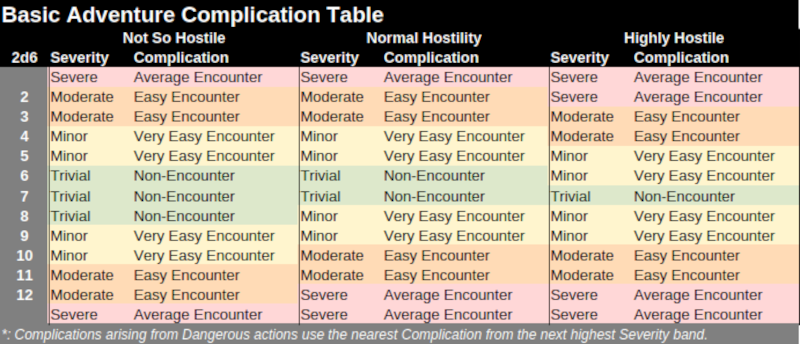
That simple version of the Adventure Complication system is enough. It’s basically just a wandering monster system, and it’s enough to start running adventures on the Tension Clock. The next time I return to this topic, though, I’ll have a much heftier Complication System for y’all.
Great article! I’m excited to try this system out.
Since complications are delayed effects, what’s your advice on how to space multiple complications that have been rolled but not yet been paid out? Say they take two risky actions back to back and you roll a 1 each time.
I cannot wait for the meatier complications tables, but for the TIME being, this is all gold, platinum and 2d6 of gems & jewelry!
Thanks again!
This is making me giddy. This will be pretty east to integrate into my games when I start running again, because I’ve always treated time as more about perception than counts of ticking seconds; this makes it all ‘realer’ without compromising that.
One thing I’m particularly thinking about is from this: “Or just make Short Rests last several minutes. That works too.” I already had a house rule that Short Rests are ‘about ten minutes’ rather than ‘about an hour’, since an hour long rest in a dungeon situation seemed unnecessarily long, and ‘about a minute’ is obviously too short. But when traveling overland etc., about an hour for a lunch break seems about right. I think maybe when using this system, you’ve got an easy hack staring at you: a Short Rest is ‘add one die to the current tension clock’. Does that sound crazy?