

Let’s talk the wilderness: wilderness adventures, wilderness travel, wilderness trekking, exploration, whatever. I don’t care what the hell you call it. It’s all the same.
Of everything Game Masters struggle with, the wilderness is certainly one of them. I get a lot of requests to talk the wilderness and no amount of talking the wilderness seems to be enough.
Many of y’all complain to me that you just can’t seem to the wilderness right or that the wilderness doesn’t feel the wilderness. Or whatever. Just like I don’t intend to argue with my detractors, and even deleted a whole paragraph that called out romantasy slice-of-life-bullshit in ren faire costumes and gronardy open-world goalless faction hexploration, I’m also not going to unpack each and every question and complaint.
You know what else I’m not going do today? I’m not going to talk about how games like Dungeons & Dragons and Pathfinder have suck-ass the wilderness mechanics and tools. It’s not that I don’t think the tools suck. They do. The tools even suck in the games that claim to have better tools for the wilderness. Games like Old School Essentials and Forbidden Lands. They just suck for different reasons. I just don’t feel like unpacking all that shit again.
I do plan to spend most of this coming spring telling y’all all how to build and run better the wilderness. I plan to offer rules, procedures, adjudication tips, and design advice. Most of it will focus on the modern roleplaying gameplay experience, of course, because that’s my thing. The vast majority of you, like me, mostly run one one of the world’s roleplaying games. You know which I mean. But a lot of the core concepts and design advice will work for whatever.
What I want to rant about today, though, isn’t the rules. I want to rant about your mindset. Your attitude about the wilderness. It’s not about what the rules tell you to do; it’s about how you try to use those rules or what you think the rules should look like. It’s about how you think the wilderness should work. I don’t actually care whose fault your crappy mindset is, I just want to fix it before I try again to give you better tools.
In other words, this rant is all about why you suck at the wilderness, and I don’t care that it’s not your fault.
The Wilderness as a Liminal Transitional Morass
When you get right down to it, Game Masters pretty much handle the wilderness in one of two ways.
First, there’s the way of the modern Game Master. That’s when the players say, “We go to the destination,” and the Game Master asks the players to make a few rolls to see if they get lost on the way, and then maybe rolls to see if they’re accosted by random crap. Most Game Masters don’t do more than one random crap accostment roll, by the way, because random crap isn’t exciting enough to be worth dragging out the travel for.
As always, there are variations on a theme. Maybe the players roll to not get lost every day. Maybe the players get to declare a specific pace. Maybe everyone gets to pick little jobs off the duty roster. You know, maybe someone’s foraging and someone’s navigating and someone’s rolling to prevent surprise rounds during random crap accostments. None of those mechanical details really changes the core of the approach.
Details aside, this is the realm of the current flavors of Dungeons & Dragons and Pathfinder and also other games like Forbidden Lands.
Then, there’s the way of the old school. That’s when the players move hex-by-hex across the wilderness like they’re scouting out a Starcraft or Stormgate map. In each hex, they learn whether it contains a bunch of trackless forest or a bunch of trackless hills or whether there’s a dot in the middle that represents something actually fun to do. There’s a lot of logistics and a lot of marking off the proper number of rations and shit like that. There’s also a mechanic for getting lost, but that’s more about whether you’re in the hex you think you’re in or not. And, of course, there’s random crap accostment tables keyed to terrain types and times of day. But unlike the modern approach, there are no limits at all on random crap accostment. You can get accosted ten times a day if that’s what the dice say, and the random crap is truly random. It doesn’t care what level you are.
Obviously, this is the realm of every kind of Dungeons & Dragons published before the turn of the millennium and every game based on such, like Old School Essentials, and also, weirdly, parts of Forbidden Lands. Talk about the worst of both worlds.
As I mentioned, I mostly talk about modern gaming. That’s because I like actual fun game design instead of dull, heartless simulation for simulation’s sake. So, I’m mostly going to talk about the first approach, the Travel Bar approach, rather than the second Hex-by-Hex approach, but I do want to admit that the Hex-by-Hex approach actually does have a lot of strengths. Unfortunately, it’s also held back by the slight weakness that it’s incredibly dull and time-consuming and sloggy and overly abstract and also obsessed with bookkeeping and logistics. That’s fine if you like that sort of shit, but it’s not what’s engaging about exploring the countryside in a fantastic world of fantasy adventure.
Really, the modern approach exists because people found the Hex-by-Hex approach dull and sloggy and time-consuming and abstract and bookkeepy and so, with each iteration, they cut out more and more of the crappy bits, but didn’t replace them with anything. So, now you have a system that’s basically just roll a die to travel with maybe something random happening on the way. That’s basically like running a dungeon by asking the players to roll once to find the boss room and then seeing if they fight some minions on the way.
The core issue is that the wilderness, in either case, is just the space between the locations. In the modern approach, you roll to pass through the space, pay the resource cost, and maybe have a fight on a forest battle map. In the old approach, you navigate an empty sea of wilderness, one trackless bit of terrain at a time, looking for points of interest like islands in the sea, to plunder for treasure, and then you make sure the ship’s ledgers are up to date.
To most gamers, the wilderness is just a transitional space. But it doesn’t even provide a very good transition.
Letting Randomness Write the Adventure
The single biggest mistake everyone, old and new, makes because of this whole transitional, liminal wilderness thing is an over-reliance on randomness to create fun, exciting gameplay. That’s fair enough if you’re an old schooler, because randomness is how you simulate realism, and that’s really stupid important to you, but if you’re a modern gamer, you really should know better.
When, for example, is the last time your players had an actual, planned, scripted, designed encounter in the wilderness? An encounter that was built just like any you’d drop in a dungeon room, whether a combat, a social interaction, a puzzle, a trap, a riddle, or just a weird thing to poke and prod at?
I see some of y’all have your hands up. Good for you. Let me ask when the last time that happened while the party was in the trackless wilderness in the gulf between where they started and where they were going?
Most Game Masters of either school don’t plan wilderness encounters. Instead, they make random encounter tables, or they just use the ones in the book. Now, I have nothing against random encounters and random complications. I use them all the time. But I never, ever ask them to actually hold up the gameplay. Random crap is incidental. It’s extraneous. It’s minor happenings that add a bit of chaos to the adventure lifestyle. They aren’t the adventure.
Think for a second about everything I’ve told you about planning your adventures and encounters to provide the best gameplay and narrative experience you possibly can. Think about the stuff I’ve been talking about lately. Think about how the order of encounters matters. Think about golden paths and tutorializing and empowering your players to win. Can random encounter tables do any of that?
Encounters and interactions are the gameplay. They’re where the players actually play the game directly. All the other stuff like resource management and abstract planning and high-level, high-concept logistics? That stuff affects the gameplay, and it’s affected by the gameplay, but it’s not the gameplay. When you spend all your time worrying about logistics and resource management and leave the encounters for random tables to handle, you’re basically putting all of your resources into the suckiest parts of the game and letting the dice handle the most important parts.
Now, I know the counter here is that you can’t plan fixed encounters in the wilderness because it’s not constrained like a dungeon. In dungeons, the players can only move from room to room via the hallways you’ve drawn. You can put encounters in the rooms, knowing the players will encounter them. But the wilderness is just an infinitely open expanse for encounters to exist in. If you say the hodag lurks in the ten-foot square at 46°00’44.4″N 89°52’35.5″W, that’s all well and good, but how do you know the players will pass anywhere within the four hundred squares with line of sight to the hodag? And that’s assuming the hodag just sits there for days or weeks instead of wandering off to terrorize some skiiers or fishers or just visit the local Beef-a-Rama festival.
There’s a long answer to that question that has to do with wilderness adventure and encounter design that I will eventually provide, but the short answer is just to not put encounters at precise points on the map. Instead, you plan them by contingency, condition, path, or zone. For example…
- Bandits wait along the old trail to attack passers-by
- If the heroes pass within 18 miles of the dryad’s grove, the dryad will approach them
- A party in the orc hunting grounds will be attacked by a hunting party once each day
No, this ain’t the same as quantum ogres. Don’t even bring that shit up.
But this talk of wilderness encounters also brings up another major problem with your stupid mindset.
Spitting Distance Encounters
Why Random Complications?
Random encounters and random complications are extraneous, incidental happenings of minor chaos. They can’t hold up the gameplay, but they do serve a vital gameplay purpose. When there’s a chance of a random incident every so many minutes or hours or days of adventure, there’s a cost to exploring and a consequence to inefficiency and navigational fuck-uppery.
If the players decide to spend an extra day wandering off the beaten path to check out some random point of interest in the distance, that means an extra day of random chaos chewing up their resources. Maybe it’ll be worth it, maybe it won’t, but if they think dicing on exploring might be rewarding enough, they’ll pay that price happily. That makes exploring a meaningful choice, but also a calculated risk. If the party’s just trekking between towns and has plenty of supplies and no deadline, the extra incidents are a cheap price for a potential payoff. On the other hand, if they’re far from home and on a desperate mission, random complications are costly.
That’s even more true when it comes to inefficient choices. If the players search the same room over and over because they’re convinced they’re missing something, every ten minutes they waste there risks an extra problem and the resource cost of dealing with it. Similarly, random complications are part of why getting lost sucks, whether it’s because you failed to navigate or because you got turned around in the dungeon and didn’t keep a good map. The extra time you spend retracing your steps means extra complications gnawing at your reserves.
In truth, random complications make the passage of time meaningful without you having to contrive tight deadlines and ticking time bombs.
I accidentally started a big thing in my support Discord server last weekend by asking a simple question about scouting. The resulting discussion revealed just how badly the best Game Masters in the entire online community misunderstand wilderness encounters. Because, obviously, I’m the best Game Master in the online community, so you must be pretty great too if you consume my work.
Y’all start wilderness encounters with the parties close enough to fit on a Standard Encounter Battlemap™, and y’all need to stop that shit. A wilderness encounter should not begin with the belligerents a hundred feet apart. I understand why you do it and why you think it’s right, but it also prevents your the wilderness from feeling anything like the wilderness.
In dungeons, encounters start at spitting distance because that’s what the environment allows for. You can’t see through walls, and you can’t see beyond your light source or your senses, so most encounters start on opposite sides of the same room or at opposite ends of a 50-foot stretch of hallway. But that isn’t how the wilderness works. In open, reasonably flat terrain, players can see an encounter coming a mile off, and they can be seen at the same distance.
By definition, encounters start when the player party encounters something. In other words, encounters begin the moment the players are aware of a presence and can react to it in any way. Even if direct interaction isn’t possible because of the distance and even if information is limited because of how light and line of sight work, the moment the players know something is somewhere, they can start doing something about it. They can choose how to approach or even choose not approach, and they can try to gather more information.
The problem is that I don’t think most of you know how your human senses actually work. Or that you even have the senses that you do. Frankly, this baffles me because I thought most of you were actually human people.
When an encounter starts at spitting distance, everyone can see and hear pretty much everything about everyone. That’s putting aside deliberate concealment, of course. Apart from someone sneaking or hiding or otherwise concealed, if the encounter happens at fifty paces, you can see everyone clearly and hear them clearly and identify them and know what they’re carrying and all that crap.
But now, suppose there’s a party of orcs moving across the plains a mile distant. Human eyes can discern movement against terrain at that distance, but that’s also just about all human eyes can discern. Assuming, of course, that it’s a small group of human-sized things moving around, which you can guess. That is to say, if a few human-sized creatures are moving a mile distant, you can see that there’s something moving, and that it’s not huge and not an army. You can also tell whether it’s coming toward you, heading away, or moving laterally. Of course, if it’s not moving, you’re less likely to see it at that distance. Maybe you won’t spot a stationary band of orcs until you’re half a mile away. Then, at a quarter mile away, you can guess that it’s a handful of medium-sized humanoids, armed and armored, and dressed in black and red. At a thousand feet, maybe you can see, “Those look like orcs.”
As soon as the players’ characters spot the orcs, however far they be and however much they can discern, they get to decide what to do with the information they’ve got. If all they see is movement a mile distant, the players can decide to approach, retreat, circumvent, or dispatch a scout. They can choose to lay an ambush if the orcs are approaching, they can freeze in cover and hope not to be noticed, or they can wave wildly, hoping to be noticed.
The orcs, meanwhile, get to make the same decisions based on what they know. The Game Master handles that.
As the relative distance between the players’ characters and orcs changes, the Game Master relays more detailed information, and the players can make more informed choices at every step. So can the orcs. The two parties can even react to what they can see the other doing.
If the terrain ain’t so clear, though, the story’s different. But also, it really isn’t. In a forest, you can’t see more than a few hundred feet in any direction because of trees and the rectilinear propagation of light and shit like that. Hell, you might not be able to see more than a few dozen feet if the ground cover’s dense. But you can still hear.
You probably don’t realize how noisy moving through overgrown terrain gets. Even if you’re a sneaky bastard.
A few orcs moving through the forest at a reasonable pace can be heard quietly crunching and rustling around from about a quarter mile away. The players’ characters won’t be able to tell what, exactly, it is they hear. Maybe it’s a small thing close by or a big thing far away, but they know a rough direction and whether it’s getting closer. So, approach, retreat, circumvent, hide, scout, call out, wait? As the distance closes, the indistinct noise becomes the footfalls of a party, the jangle of armor, and the sound of voices. Eventually, you can pick out the guttural sounds of one of the orcish languages, unless they’ve stopped talking, which might tell you something about their intentions.
Then you can see the orcs a hundred feet away coming through the underbrush.
Note that this shit ain’t just about gameplay. All this cat-and-mouse approach-and-retreat with information limited by your crappy senses bullshit is what makes wilderness encounters feel so different. If every forest fracas starts on a map the size of a dungeon room, then it just feels like you’re fighting in a particularly well-ventilated, fey-themed dungeon. That’s on top of the fact that some encounters pass like ships in the night after a tense few minutes of bracing, and you never, ever know what the hell you almost got eaten by. Scary shit.
Further, all that gameplay leading up to an encounter that maybe doesn’t even happen helps balance the fact that the wilderness is less densely packed with encounters. You might only have one significant encounter in a day of travel, but that may involve four in-game world hours of evading a creature you can’t identify before you decide to hunker down and ready an ambush because it’s clearly got your scent and is not giving up the trail.
The Terrain as Tiled Background
Let’s talk about how maps lie to you. How hex maps lie to you — because hex maps are for you and you alone; players shouldn’t have and should not be allowed to draw hex maps. That’s horseshit. I don’t understand…
Sorry…
Let’s talk about how maps lie to you. How hex maps lie to you and how normal maps like would exist in the world lie to the players — because those are the maps players should have. Players should either have a map that represents a literal, actual map their characters have, or else, they should have a map that represents their general geographical knowledge of the local area. Players shouldn’t even get scales on their maps unless they pay a fortune for them. I don’t understand…
Sorry…
Maps lie. All maps lie. They present a sort of empty, tiled background on which are placed dots that represent actual, interesting things. If you’re not in a dot, you’re moving against an indistinct background image of basically blank forest or blank grasslands or a blank road.
Let’s imagine we’re looking at a forest on an imaginary hex map. I don’t need to draw one; you know what they look like. A blob of green hexes, each with a tree symbol drawn in the middle. That thick blue line on the edge? That’s a river. That dot? That’s the ruins of the Old Forest Temple. It contains Korok’s Peridot or some shit like that. That thin, dotted, brown line? That’s a trail. The rest, though, is just forest. Just trees and bushes. Just a repeating mosaic of eight-pixel background tiles scrolling along behind Link and Mario.
Now, what would you say if I told you that Link and Mario cross water every second or third hex? Mostly, they just step over it, or maybe they walk across a few feet of ankle-deep water, but occasionally they’re up to their knees in water wider than they are tall. If you’re in a normal temperate forest and it ain’t a drought, you cross or pass water three to six times a day, and none of it’s marked on your map. Why not? Partly because it ain’t substantial enough, and partly because medieval fantasy maps don’t come from Google satellites, and partly because it’s seasonal drainage and it rises, falls, and changes course over time. There’s always drainage in any non-arid terrain.
That’s why, by the way, player characters can survive most temperate treks with a single waterskin.
Let’s do trails now. Let’s say the players are following that brown, dotted line. It ain’t an actual paved road, just a worn trail through the vegetation that goes around the trees and follows the contours of the land. A reasonably visible track of dirt or very sparse ground cover with the forest on either side. What would you say if I told you that the party, at least a few times, encounters unmarked trails crossing theirs or forking them? Water and animals wear trails through the forest. When it’s animals, we call those game trails, and lots of them tend to end at water, incidentally. Some are subtle. You could walk right past them and not even see them. Some are just animal tracks under the ground cover. Others, though, look like the trail you’re on. That’s why we mark hiking trails so clearly. That’s why you can get lost following a mapped trail on your way to get the Korok’s Peridot from the Old Forest Temple.
In fact, navigating through trackless wilderness often involves following the trails that already exist. They’re the path of least resistance through the wilderness, by definition, and so they’re the easiest way to cross a forest. Provided, of course, you have a good sense of direction and always pick the trails that go in the direction you’re going.
Now let’s talk about all the hexes along and around the thick brown line meandering through the plains between one city and the next. Let’s talk about empty hexes in civilized lands.
First, there are a lot of roads that aren’t marked on any map. They’re small roads, tracks, and trails, splaying off the main road or meeting it at crossroads. Those don’t generally create confusion because actual, constructed roads are pretty clear and have a hierarchy, but in some of the dustier, more distant edges of civilizations, you can come to a fork that’s not on your map and take the wrong road. Where do those roads go? They go to small hamlets and clusters of farms. Most are too small to even have a name, much less warrant a dot on the map. Hell, a party in civilized land on a road between any two settlements of reasonable size should pass through or within sight of at least one small hamlet or market square surrounded by farms at least once a day. That’s notwithstanding the number of abandoned buildings, abandoned hamlets, roadside shrines, campsites that have been used and reused so often by passers-by they’re practically permanent, and small ponds and streams with or without simple plank bridges or gravel or stone fords.
My point is not that you need to stat all this shit up and fill every hex with something. I’m not telling you to play out seven river crossings and three village visits every day the players go trekking through your the wilderness. Most of this crap is minor and incidental. But it also gives the players some opportunities to interact with the world. Even if there’s no substantial challenge, making the players play out the choice to head up or down an unexpected, unmarked river to make a crossing or go around a pond brings the wilderness to life. So does letting the players have some nothing interactions with the washerwoman at the crossroads’ well in the middle of a spatter of farmsteads.
If you don’t realize there’s always minor, interesting things to see and do in every hex, you condense your travel down to, “You follow the road for three days and lo, in the distance, you see the City of Townsbury-and-Castle.” That makes your travel feel like the players are just watching a bar fill on a loading screen. Or, just as bad, rolling abstract navigation checks to fill it.
Or, if you’re more of a Hex-by-Hex dude, you condense it down to, “This hex is full of forest. Let me roll to see if something interesting happens. Nope. Draw a forest in the hex and then pick a direction.”
This shit also makes your random encounters boring as hell. All random encounters in the wilderness take place on either completely blank maps, maybe with two lines to show the edges of the road, or else a stolen map that’s basically tiles of vegetation with random trees scattered around. Why don’t your encounters ever take place in glades or clearings or grottoes or atop bluffs or below bluffs or around deadfalls or along streams or next to ponds or at crossroads or in an abandoned camp or by a roadside shrine or under a spreading giant willow or across a plank bridge over a muddy stream? Because blank hexes are blank; they’re just background. That’s why.
And it sucks.
The Wilderness Ain’t Fast So Slow Your Roll
You’ve probably noticed all the above crap is definitely going to chew up some table time, and you probably don’t like that. I get it. Because the old Hex-by-Hex with Bonus Logistical Bookkeeping approach bored the crap out of so many gamers, there’s been this move in modern gamesto streamline the whole the wilderness thing. Let the players pick jobs, roll some dice, accost them once with random crap, and then move on to the actual fun gameplay.
I get that. I agree you shouldn’t waste too much time on what amounts to transitional gameplay. Assuming it really is just transitional, of course. The wilderness isn’t always merely transitional. That aside, I don’t want to spend session after session after session on a the wilderness trek any more than you do. But, I also don’t want the the wilderness to pass unnoticed. I want the players to feel like they crossed a the wilderness to get where they meant to go and that it wasn’t trivial.
Streamlining works against that. Even if a the wilderness trek really is just a boring, three day hike down the road, and even if the party’s not accosted by random crap and they don’t have to overcome significant challenges, it’s still worth letting that the wilderness trek fill a half hour or a quarter session or whatever. Let it take up some space, even if it’s dull, low-key play that’s mostly just description, a trivial decision, and a few minutes of reading the plaque on a monument or searching an abandoned campsite for forgotten pocket change. That, too, makes your the wilderness feel like the wilderness. The wilderness is slow to cross and kind of dull except when it’s trying to kill you. It is just a gulf between you and where you want to be that takes time to cross and tires you out.
Let the players feel that.
Players Are Always Lost
Let me end on a point I’ve made before. A point I keep making and one that keeps failing to land.
You see, there’s this really dumb, stupid, vestigial, bullshit game mechanic that comes from the Hex-by-Hex days. In those days, you really did just hand your players a blank hex map to fill in one tile at a time. Check out the classic module, X1: The Isle of Dread, written by Moldvay and Zeb and first published by TSR in 1981. It’s one of the most published D&D modules of all time, and it was literally designed to teach players how to crawl a hex crawl.
See this?
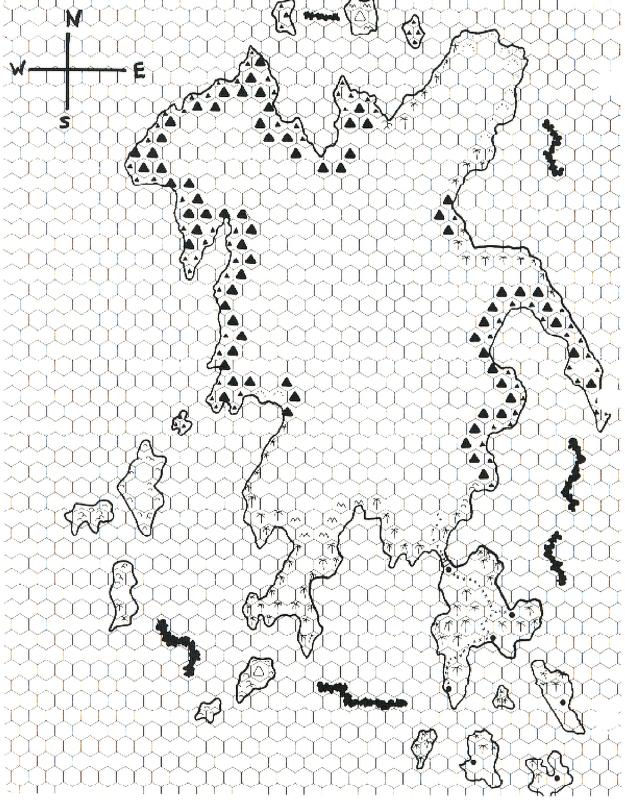
Image © 1981 by TSR Hobbies, Inc. Source: Dungeon Module X1 The Isle of Dread by David Cook and Tom Moldvay. This content is used under the fair use doctrine as defined in 17 U.S.C. § 107.
That’s the blank map you were meant to give to players to fill in as they mapped the titular landmass. I include that because I always get accused of misrepresenting the way old-school games were played, even though all y’all keep forgetting that I was there when old-school was just called gaming.
Anyway, there’s this really dumb, stupid, horseshit mechanic that’s a holdover from those days. It’s called Getting Lost. Basically, if you were in the wilderness and you weren’t following a path — like a river or a road or trailing an orc warband — you picked a direction to move in. Then, the Game Master rolled a secret roll to see if you actually managed to keep true to the direction you declared. If not, you got lost. That meant you weren’t in the hex you thought you were. The Game Master would track your actual position and describe what you found in each hex, but you were marking the wrong hexes, and all further navigation started from a different hex than you thought.
For the time and given the hex crawl mechanics, that wasn’t a bad mechanic. It made sense. Moreover, the idea behind it makes perfect sense.
Most people have no idea how hard it is to walk in a straight line for hours or days. You actually can’t. At all. Terrain and trees and ponds and shit don’t let you. You’re always going around something. It’s also really exhausting to go in straight lines because of slopes and hills and things. You don’t go up and down hills, you go around them, or, at least, you try to find something gentler than the steepest and most forbidding of slopes. But even if you could walk in a straight line, it wouldn’t help that much.
Under ideal conditions, normal people have decent internal compasses. On a clear day, you can generally keep to a straight line if the terrain lets you. But your compass isn’t perfect. When it comes to reaching a small location a long way away, like a dot several hexes distant, you need it to be perfect.
Let me put this into perspective for you…
Hold your hand out at arm’s length in front of your face. See your pinky? See the nail of your pinky? The width of that nail is 1° of arc. If you try to walk, say, true north, and your first step is one pinky nail width off true north, in four hours, you’re off your target by a quarter mile. That’s assuming every following step for four hours is perfectly straight.
Speaking of, do me a little favor. Check the position of the sun out your window right now. Now, pinpoint true, proper north within a pinky nail of accuracy. I’ll wait.
Now, let’s add going around an obstacle. Say there’s a tree in front of you. Walk around that tree. Exactly around. Like directly across from where you started. To within a pinky nail’s width. Now, pinpoint true north again to the pinky nail standard, take one step to the pinky nail standard, and keep going. Perfectly straight.
Which, by the way, is the other problem. You don’t walk straight. No one does. Humans don’t. You can’t. Your body isn’t perfectly symmetrical. Your stride isn’t perfectly even every time. That’s bad, but what’s worse is that you don’t wobble, you curve. Whenever you’re off straight, you’re always off in the same direction. If you wobbled, the errors would average out. Kind of. Now, without knowing it, you do correct this somewhat based on your internal compass, but you don’t correct it perfectly, and your compass goes really bad in even slightly subpar conditions. Overcast sky? Under the canopy of a forest? You curve bad. Even if you could phase through trees and hills and walk on water, you curve bad.
How bad? It varies from person to person. But a reasonable person without a clear view of a perfect sky overhead tends to drift to one side about 20 feet for every thousand feet they walk. That’s a noticeable arc. Five miles like that and you can end up going in a circle. You know that thing on TV and in comics when someone says, “I think we’re going in circles?” The thing that seems stupidly impossible. It isn’t. It happens. In as little as five miles. That’s less than two hours of hiking. In a forest or under a cloudy sky, you can walk in the same circle four times in a single day.
That’s why navigation is an actual skill you actually have to roll. Because it’s hard not to end up walking in circles four times a day, even without the pinky nail standard.
Add to this inaccurate maps, incorrect trails that look like the right trail, unmarked rivers and features in so-called empty hexes, trees, hills, ponds, and the idea of just walking on center from one six-mile hex to the next becomes utterly and completely ridiculous. Roll to see if you get lost? Fuck you with your die roll; you’re lost. You’re always lost. If you’re not actually at an identifiable dot on the map, you have no idea where you are. Even if you’re following a road or a river or tracking a distant mountain peak that totally can’t be easily mistaken for any other mountain peak because all mountain peaks look the same and vanish as soon as it’s hazy or misty, you still have no idea where you are. You may know you’re somewhere along a specific path or within sight of a specific thing, but where exactly are you? No one knows. No one can know.
Speaking of, there’s a similar speech I can give about how the idea that you have a set speed in miles per hour that never varies in a given terrain is also asinine. Just assume I gave it.
The point is, until you arrive at a very precise location you can positively identify, you can be anywhere on the map. Within reason, obviously. One patch of forest or grassland or stretch of road is the same as any other, your speed and direction are constantly changing, and you can’t even walk in a straight line at a steady speed for a whole hour without years of training and practice.
You’re lost. This is what the rulebook should say.
Getting Lost
Yes.
When you boil travel mechanics down to “roll to not get lost,” “oops, you’re lost; roll to see if you know you’re lost,” “okay, you know you’re lost; roll to recover from lostness,” you’re ruining the wilderness. You’re treating the players like they’ve got a GPS system with a 35% chance to glitch and a 65% chance to reboot when it does. And this ain’t a mechanics thing. Yeah, the mechanics are bad, but whenever anyone talks to me about ways to fix the the wilderness, they always talk about getting lost, and it’s always like this. People think these rules are actually the one thing D&D is doing right!
As I’ve said before, the proper way to navigate is to follow a trail, follow a landmark, or plot a route that involves hiking to features you can’t miss, even when you miss them. If you aim for a river, it doesn’t matter if you’re a few miles off by the time you get there because the river cuts across the whole landscape. If you’re just aiming to cross the forest, you’re going to hit a treeline even if you can’t keep true. Once you’re on the other side and your crappy, imperfect internal compass is sort of online again, you can make a rough guess about where you came out and what rough direction will get you to the next big feature. Or you can walk along the edge of the woods until you find the road or the village or whatever.
The inability to follow hallways and the consequent need to constantly guess where you are and what rough direction will get you somewhere unmistakable is another one of those things that makes the wilderness feel like the wilderness. Ask me, by the way, what I think about the node-mapping approach to wilderness some people espouse. Except don’t bother because my answer won’t be informative and it won’t be polite.
Meanwhile, you thinking that being lost is a rare failure state because of a crappy die roll instead of just the default condition of being in the wilderness is why you can’t fix your wilderness.
All of that said, you do need some better mechanics and procedures than the shit roleplaying games give you. I am working on that. That’ll be our little springtime project. Meanwhile, I’ve also got a spiffy little bonus tool to tie into everything I said about contact and sensory limitations. It’ll be done in a week, and I’ll be giving it away to my Frienemy-tier supporters on Patreon and SubscribeStar, and I’ll let the rest of you have it for a few bucks via Patreon or the Angry Games shop.
Trust me; I’ll let you know when it’s available.
The last time I had a planned wilderness encounter that wasn’t actually at the destination was last Friday night.
But I’m cheating, it was the thing they were looking for, they just ran into a patrol prior to getting to the spot they were supposed to reach to search from.
They did have a three day walk, and I did spend some time on preping for the journey and on the fact that since they were going through arid terrain they’d want four day’s water for the three days to the next river and that water is heavy and they did have a random find of a waterhole on the way which their ranger looked at and said, “Don’t drink from this one.”
But it was basically, “You walk three days to the adventure.” Looking forward to more concrete suggestions on ways to do better.
Thanks a lot for writing on this and I’m really looking forward to see your mechanical approach to this.
I’ve actually done wilderness exploration scenarios with planned encounters twice in one of my running campaigns. I used the first scenario to provide them with a guide and to teach the players the ropes of how the scenario would work, so they could do the second and much harder scenario on their own. In each, I used your shift system to make the spent time and the decisions of the players matter, without adding complex book keeping.
My prep notes do use the adventure hex map, but I’ve gone and shaded the areas, where the planned encounters can occur in, much as described above with the examples of the bandits or the ork patrols. I made sure to watch some nature documentaries with the special terrain that these tracks would cover in order to be able to provide my players with good descriptions of the vignettes that they would encounter that might be inconsequential, but that make a climb in the alps different from a hike in the everglades.
I absolutely love to use the results of randum encounter rolls in the wilderness to hint at potential dangers. Those two witches and 4 scarecrows? All the players find are a pair of human footprints and a strange print that almost looks reminiscent of cuneiform writing. Or they find the mangled corpse of some hunters or an animal slain by a troll, maybe giving them a means to learn something about the creature beyond signalling its presence. Now, if players aren’t careful, or they choose to take long rests in dangerous wilderness, they might be accosted by whatever left those prints.
I love running wilderness exploration, because it lets me paint a lot of themes before ever encountering the adventure site. The players, hooked with information and wanting to learn more, can make choices based on their information at the time, which makes clues that they uncover about the surrounding land and creatures itself valuable.
I’d say wilderness can never be merely transitional. It’s a contradiction in terms. If a merely transitional journey crosses actual wilderness, there should be some narrative highlighting why that’s even possible, and it shouldn’t be possible very often.
What is “actual wilderness?”
Wilderness as you described it, as it really is, not the misconception lots of modern people have about it. I’m thinking of something like, the local ruler can’t deal with a threat in or beyond the wilderness, but they have managed to mostly clear a path to it and post some sentries, or send surveyors to make a decent map, mark some trees, etc., making the party’s journey less of an adventure in itself for a change.
I’m truly so eager for this lesson module. Last session I ran kicked off an adventure id described as “Oregon Trail through a war-zone” and I spent a lot of time trying to set up my own system to navigate the wilderness. Im very excited to see how it works in actual play, and then read about how I did it wrong and stupid and can improve it.
That said, another issue with the “wilderness mindset” comes from the players. Minor encounters (like a roadside campsite) are treated like they must be a quest hook or lead to treasure or are completely useless. Im not saying that means DMs shouldn’t do them, but it can become a feedback loop that can be hard to short circuit.
The more I read Angry, the more I realize most of his advice comes down to, “You need to understand the real world equivalent first, before trying to translate that into your game.” Which is a compliment. I am glad he’s doing the research to help make my games better. I’m far too busy getting into arguments on the internet to do it myself.
“Most Game Masters don’t do more than one random crap accostment roll, by the way, because random crap isn’t exciting enough to be worth dragging out the travel for.”
As explained by Mr(s) Wizard: https://www.giantitp.com/comics/oots0145.html