
A few weeks ago, I published this thing about mapping a pretty good dungeon. I thought it was a good, helpful thing, and many of y’all apparently thought so too. But a few of you didn’t. Some of you pissed and whined at me about it. A couple of you even yelled at me. Meanwhile, I’ve actually noticed a lot of similar bitching and moaning in the greater Game Mastering community.
So, let’s talk about maps…
You’re Spoiled By Your Maps
There’s a lot of stress around maps these days. At least, there’s a lot of map stress among those who run games online. But that’s a lot of people, especially given that many current-day gamers have never known anything other than running games online.
Meanwhile, it’s never been easier to create, acquire, and share high-quality maps with your players. It’s also never been easier for Game Masters to see what other Game Masters, professional and amateur, are doing at their tables.
Now, don’t worry: this ain’t a screed about how online gaming is terrible. That would be a completely dumbass thing to say and, as a rule, I don’t say dumbass things. Likewise, I ain’t going to rant about how professionally produced roleplaying gaming entertainment shows like Critical Role have ruined gaming. That’s another totally dumbass thing that only elitist asshats say.
But I do want to address the problem of how easy it is to make maps, find maps, use maps in your game, and see what other people are doing with maps at their tables. Because it is a problem. A big one. And it’s all down to the difference between pretty maps and good maps.
Good Maps Beat Pretty Maps
I went through this whole thing about how to plan a simple adventure using actual, good game design, right? It ended with me turning a proper adventure outline into an adventure map. But far from being impressed by my amazing feats of presticartographation, some folks were actually a bit disheartened. One comment, in particular, stood out. A reader said they’d love to follow my guidance, but they lack the skills to actually produce good maps. Their only option is to steal maps from others. They even referenced this particular line from the article…
There actually isn’t any magic to this step. This is just the creative art part of the whole dungeon-building thing. Just make a pretty map. You don’t have to worry about the plotting and planning because it’s already done. The plot and plan are the things you’re mapping over.
Let me be clear: I used the wrong word. Actually, I used the right word, but I hoped that context would make it clear that I didn’t mean it the way I meant it. When I said, “Just make a pretty map,” I wasn’t talking about the aesthetic quality of the map. I wasn’t talking about how nice the map looked as a piece of art. I meant, “Now make it look like a dungeon map.” Take the plan boxes that mark out spaces and draw raggedy lines that look like cave walls and color the water blue so that it would look like you were mapping a cave.
It didn’t help that, for clarity, I’d booted up my fully kitted-out copy of Campaign Cartographer 3 to make the maps for that article so they’d be clear and easy to read and that I added a few basic special effects like wall shadows to help them pop.
What’s funny, though, is that I didn’t consider those maps particularly pretty. In fact, I deliberately stopped at ugly. Those were ugly maps. I mean, look at this map…
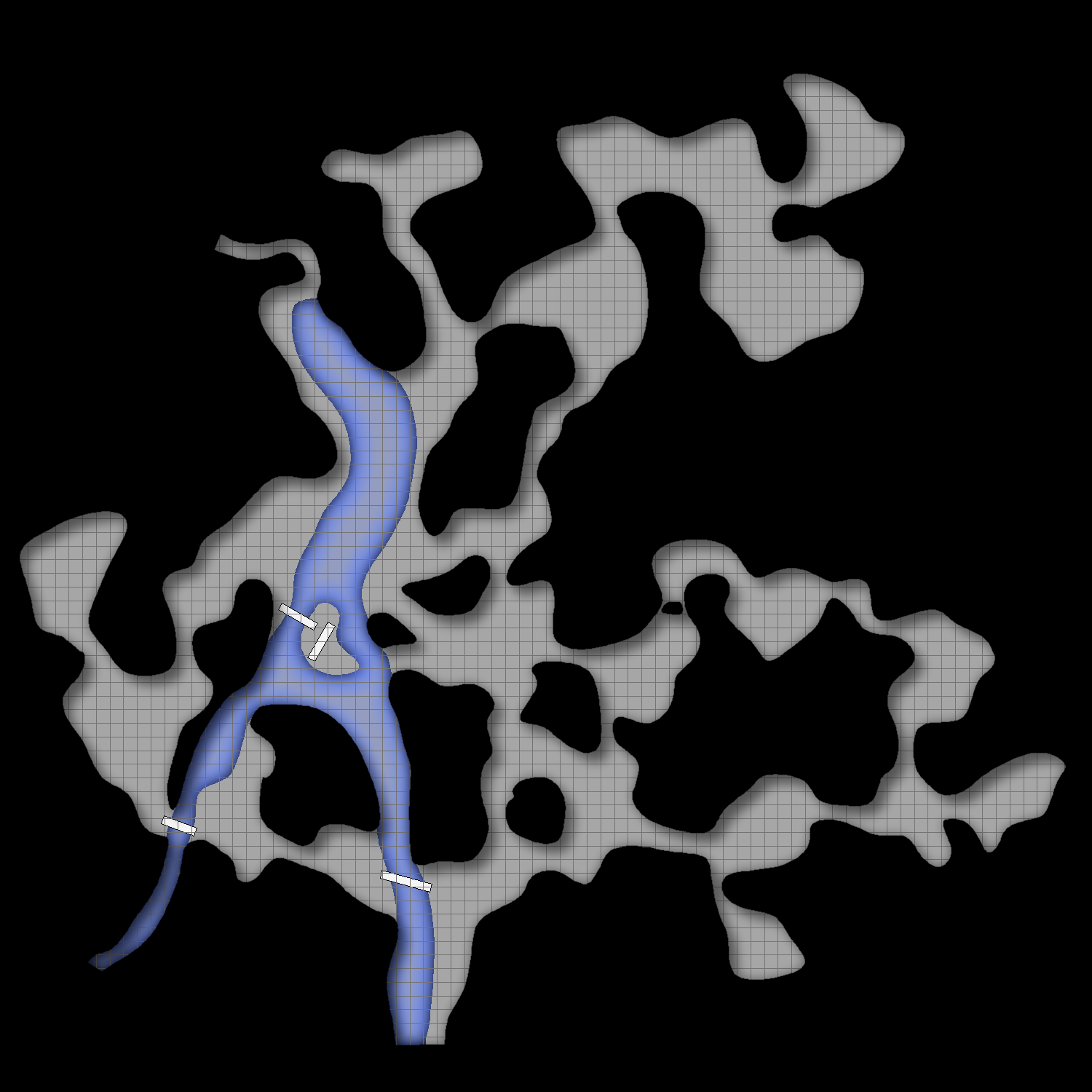
It’s just colored blobs with a grid. There’s no textures, no terrain, no sprites, no art. The bridges are just colored, outlined rectangles. I did that because I didn’t want the quality of the map to distract from the actual design.
Honestly, I regret now not going with my original plan. You almost ended up with a Sharpie marker on graph paper. Something like this…
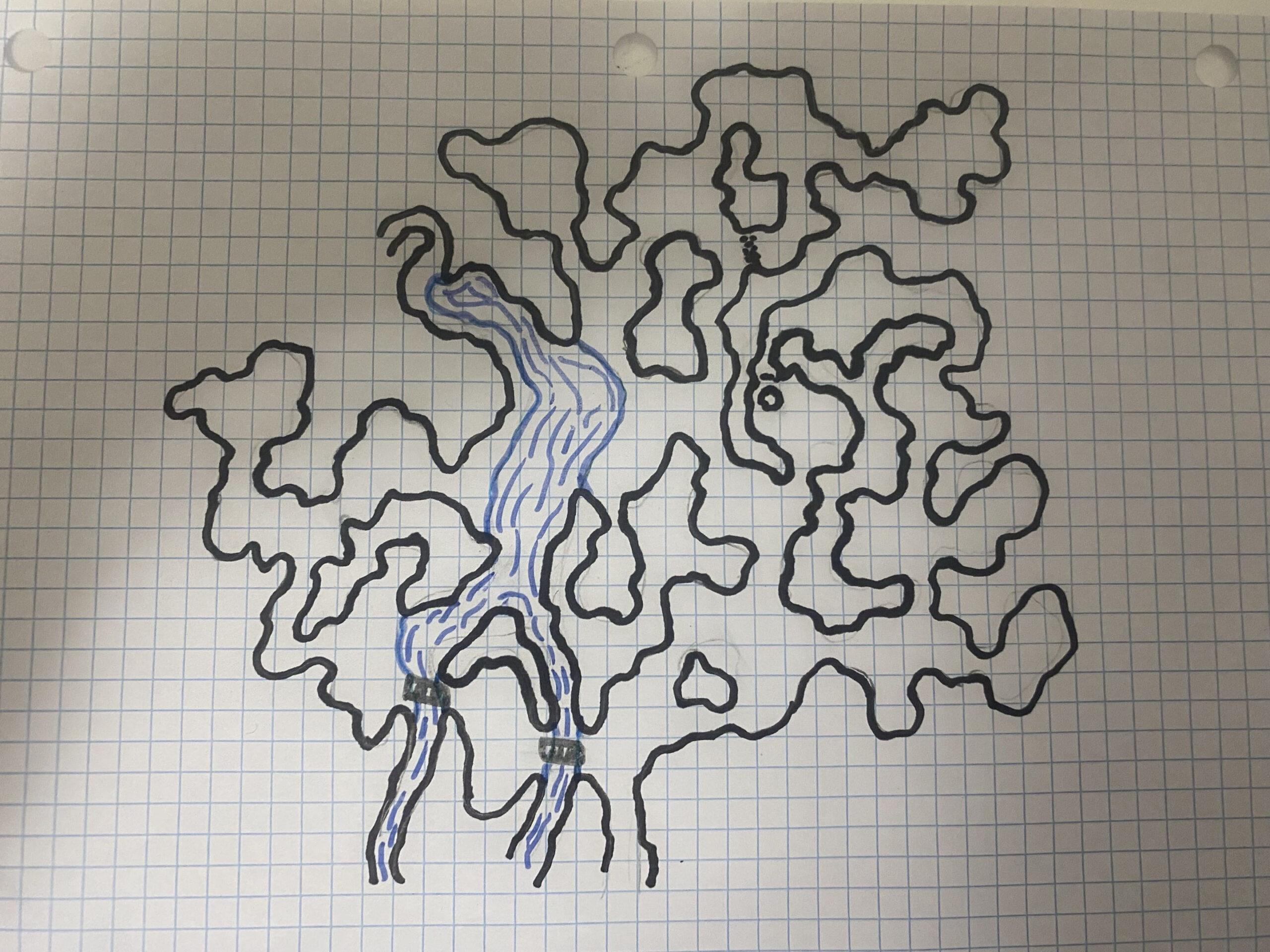
The point is that the prettiness doesn’t matter. What matters is whether the map is well-designed from a gameplay standpoint and that the map communicates the information it needs to. Presentation doesn’t matter. Aesthetics don’t matter. Even if I were using this map at the table, that crap still wouldn’t matter.
My players never know what kind of map they’re going to get. Ask them. In the same session, they might go from a gorgeous, computer-made map to a scan of a carefully drawn pencil map to a bunch of polygons hastily assembled with my virtual tabletop’s basic drawing tools to a Sharpie-on-printer-paper monstrosity captured with my phone’s camera, e-mailed to myself with a badly-fitted grid slapped on top.
I shit you not.
I can’t pretend I don’t know how to put together a pretty nice map. I’m not an artist, but over the decades of mapping for gaming, I’ve gotten good at both hand-drawing and digitally crafting gaming maps. That’s what happens when you do something a lot. Especially if you enjoy it. I like mapping. It’s fun. But I don’t make every map a work of art because I know presentation doesn’t matter. If I have the time and if I feel like it, I make a nice map, but it’s like bringing cupcakes to the table.
Good maps beat pretty maps. An ugly, player-facing map won’t ruin a good game. A beautiful map won’t save a bad game.
Remember that, when it comes to exploration-based adventures or site-based adventures or dungeon-delves or whatever the hell you want to call this mode of play, the dungeon map is the game. It’s the game design. The dungeon map is the adventure’s outline, structure, and macrochallenge. If you know what you’re doing anyway. I ain’t teaching you how to map pretty; I’m teaching you how to design actual adventures.
The map I made? You can’t have the adventure I described without the map I designed for it. Neither can you steal the map and stock it yourself without understanding the invisible, underlying structure. It won’t work. But the adventure would work just as well with a Sharpie-marker-on-graph-paper. It would also work just as well if I tarted it up with fancy textures and lighting effects and a bunch of art assets I bought from a semi-professional Patreon cartographer.
All of this is true of the temple map I shared too…
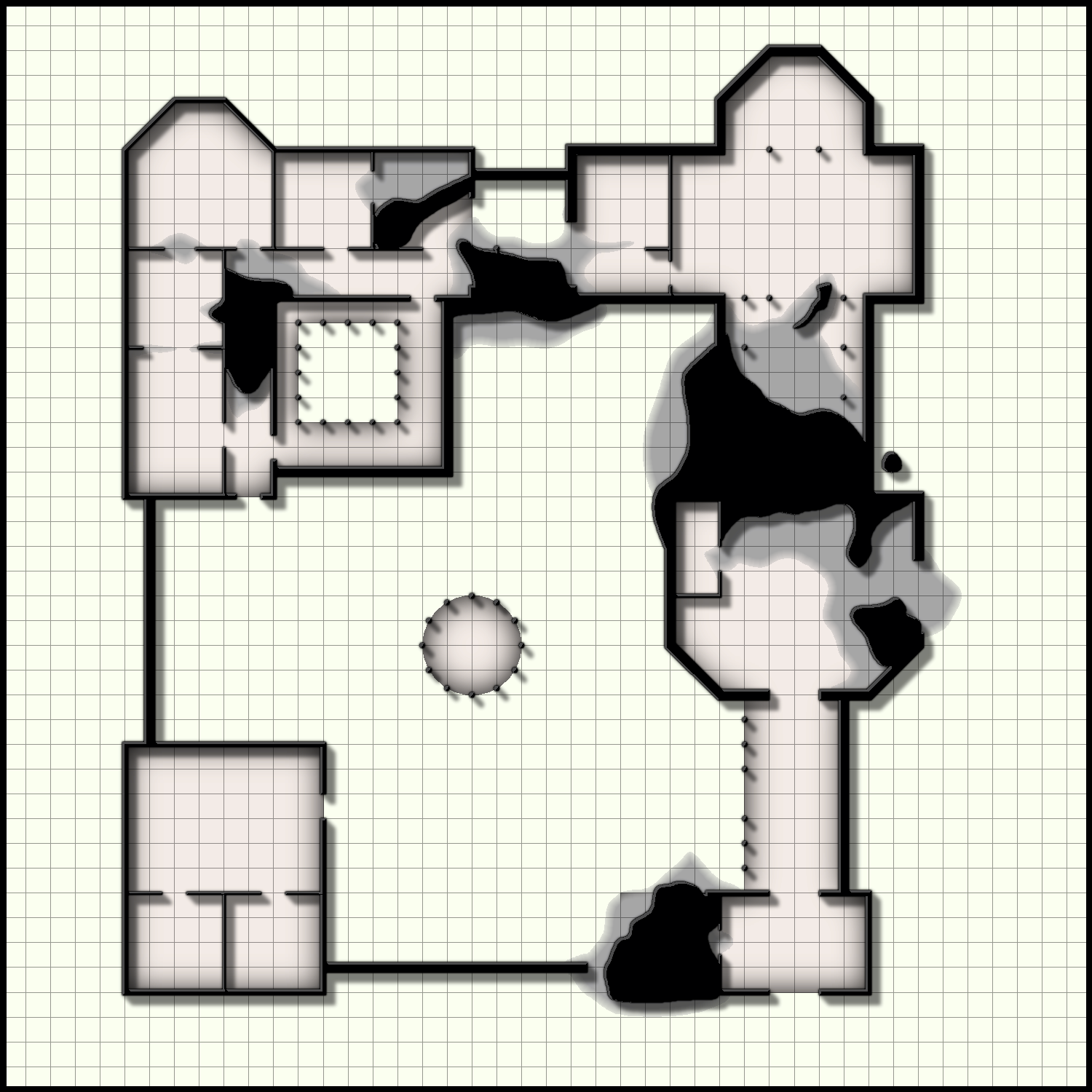
Look close. It’s just colored polygons and blobs. There are no textures, just some colored shading to differentiate interior from exterior areas and to show where the debris is. I threw some shadows and beveling on the walls to give it depth, but compare it to something like this temple and guard post at a river crossing I made for one of my recent campaigns…
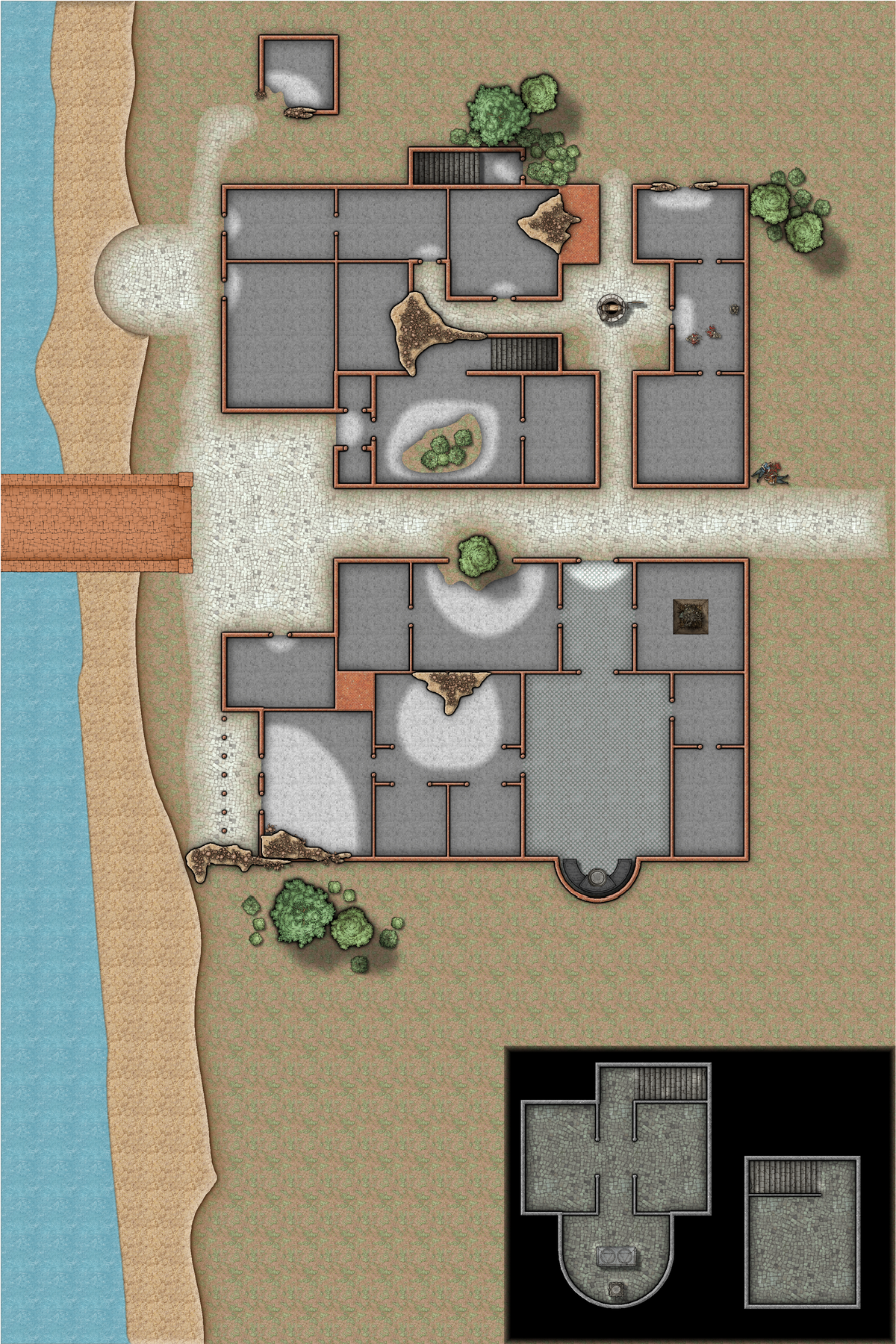
If the best you can do, or the best you want to do, or all you have time for is a pic you snapped of a line-drawing on graph paper, that’s fine. If all you’re willing or able to do is basic shapes in GIMP, that’s also fine. But it’s also pretty easy to make a decent map in an inexpensive and approachable tool like Dungeondraft. It doesn’t take that long to learn. Gone are the days when you have to spend hundreds of dollars on a complex vector-based mapping suite to get a pretty map.
Whatever you’re willing and able to do, though, in terms of map presentation, do it. But if you’re going to make adventures of your own, you can’t do it with someone else’s maps.
You Can’t Build Adventures with Stolen Maps
Despite all that I said above, my goal here isn’t to make you feel better about mapping however you can. Indeed, presentation doesn’t matter, and you need to stop comparing your game aids to other people’s, but that’s not about making you feel better. It’s about getting you to stop stealing maps.
The simple, plain truth is that you can’t build better site-based dungeon delve adventures the way I’m teaching you without making your own maps. If you can’t or won’t map your own sites, you don’t belong in my classroom. When it comes to a site-based adventure, or really, any adventure that includes any component of player-directed navigation or any tactical encounter at all, the map is the scenario. If you outsource the map, you’re outsourcing the most important part of your adventure or encounter design.
Fortunately, it ain’t your art skills that matter. Because maps aren’t art, they’re diagrams. The part that I actually taught you is the part that matters. You know, the part where you think about the space as the adventure outline and think about navigation and exploration and encounter progression?
Meanwhile, if your attitude is, “I can’t draw a good map, so my only choice is to steal one,” then you’re never going to not suck, and that’s pretty sad.
I’ll let you in on a secret: I suck at making nice maps. You may think otherwise, because you suck worse, but when I compare myself to Mike Schley and Jared Blando and Devan Rue, I hate my work. Moreover, my maps never look as good on paper or screen as they do in my head. I can never get what I imagine to actually show up.
The only reason I can make maps that you don’t think suck is that I never once said, “Well, I’m not as good at this as I want to be, so I won’t try.” The only way to get good at something is to suck at it and be unhappy with the result and keep doing it anyway. Meanwhile, the best way to keep sucking at something is to give up because you suck.
If you think your maps suck compared to mine, welcome to life. That’s how it be. Everyone sucks until they’re good enough, no one is ever good enough to be happy, and everyone can find someone better to compare their work to.
The problem is that if you use that to excuse yourself from mapping your own adventures, you’re not only guaranteeing you will always suck at mapping forever, you’re also keeping yourself from ever designing great adventures. Which is fine. There’s plenty of Game Masters who can’t design good adventures. There’s plenty who don’t even try; they’re happy just running published whatever. But if you’re already wasting an ass-ton of time reading my thousands of words of advice, then I assume you want to actually design great adventures. That means you’re going to have to start mapping them yourself.
It’s the only way.
Adventure Maps Aren’t Play Aids
I could end there, right? It’s a strong ending. But there’s another bit of kvetching I have to kick in the keister because some asshat accused me of getting my own advice wrong and ruining their game forever. Or something like that. To be honest, I don’t really pay attention when people yell at me about getting my own advice wrong.
A long time ago, long enough that I probably need to revisit because my understanding of things has evolved and I apparently wasn’t clear enough the first time based on this shrieking comment…
Sorry…
A long time ago, I argued it was bad practice to let players see entire dungeon maps, even if you hid them behind lighting and line-of-sight effects, so they could only see what their characters could at any given moment. I actually said players didn’t need a map for every frigging empty room and dead-end hall of the dungeon. I used terms like exploration map and adventure map. I don’t really even remember the whole thing, and I don’t care to reread it.
But, apparently, some people cared. They cared hard. Hard enough that, when, after nearly a decade, I had the gall to teach y’all how to draw an adventure map to scale, they treated it like a spit in the eye and a kick in the dick. Apparently, drawing actual adventure maps that look like what they’re maps of is a heresy against my own teachings.
So let me address this shit.
I don’t think it’s good gaming to put the entire dungeon in a virtual tabletop and let the players click around it as they explore. I don’t think maps should be the focus of play that much. Personally, I think the only time there should be a map on the table is if you need one to play out an encounter. If there’s a combat or a room with a complex layout the players are investigating for clues, by all means, use a visual aid. Map the room, put tokens on it, draw important points of interest, whatever you gotta do. But if the situation doesn’t need a map for you to run it, don’t bother with a map.
Except…
I understand this is totally impractical advice for running online games in 2026. It was probably kind of impractical back in 2018, or whenever I wrote whatever it was that got everyone’s panties in a jimmy about my pretty good maps today. Moreover, that advice only applies specifically for exploration-and-encounter gameplay. I could probably write a whole, long thing about proper use of maps in all modes of play in 2026 on virtual tabletops if I thought anyone cared.
But I never said you shouldn’t have adventure maps at all. Even if you ain’t going to show the players the entire map of the whole space, the Game Master can and should have a map. One that communicates everything necessary to run the game. Moreover, the Scenario Designer, the person making the adventure, should also have a map. One that allows them to, you know, design the scenario.
Now, in the past, I have pointed out that a map is just a diagram. It’s just an outline. It only has to convey enough information to let the adventure’s designer or the game’s master do the job they have to. No more. I have pointed out that sometimes, all you need is an abstract map or a flowchart or whatever. Apparently, that was enough for some people to decide they never had to properly map a dungeon again.
In theory, I could have stopped with the box diagrams I drew when planning my map. In theory, those diagrams were good enough to design and run an adventure from. Except they weren’t. They’re not. They don’t contain enough information. Especially not for the kind of adventure design we’re talking about now.
I keep trying to get y’all to understand that, over the years, I have given many different levels of instruction. I’ve given a lot of basic-ass instruction to help rank newbies run good-enough games and write good-enough adventures. But most of my readers have graduated beyond that shit and actually care about striving for more than good enough.
That’s the distinction between Mere Game Executors and True Game Masters. Or between Mere Adventure Builders and True Scenario Designers. That’s the difference between Let’s Build a Quick and Dirty Dungeon and Let’s Build a Pretty Good Dungeon.
If you just want to write a basic-bitch adventure that’s just a string of encounters to navigate on a branching path, a flowchart will do you fine. You can run a five-room dungeon or a find-the-path-through-the-encounters or a breadcrumb mystery with a flowchart. But we’re talking about real game design with macroscopic structures, navigation-as-challenge, inertia, momentum, and real gameplay. That’s more than a string of self-contained encounters to pick through.
You can’t build a navigation challenge or real exploration-based gameplay without treating the space like a space. And when it comes to communicating spatial information, maps are the easiest, most efficient, clearest ways to do it. That’s why roleplaying games have been using maps for fifty years and ain’t stopping anytime soon.
Consider, for example, the walls being a river thing and those plank bridges the players can move around to open shortcuts. That’s macroscopic navigational gameplay. It’s gameplay that moves beyond individual encounters and only works if the space is an actual space. It’s also the kind of gameplay that emerges naturally from drawing a map of the space. It’s easier to come up with ideas about navigation if you, the designer, are designing your adventure as a space to navigate instead of a flowchart.
Likewise, the possibility that some encounters might affect others also gets clearer when you map the space instead of diagramming it. Rivers aren’t walls. Goblins might be able to see and hear across the river, so combat on one side might raise alarms on the other. Those possibilities just aren’t clear on flowcharts.
Just as I said above that you can’t design a good site-based adventure if you’re not willing to map it yourself, I also have to say you can’t design a good site-based adventure if you’re not willing to map it as a map. Because if you aren’t planning the space as a space, you can’t challenge the players spatially. Then, all you’re left with is just a sequence of self-contained encounters in a maze.
So, to put this whole thing into one pithy little tl;dr: either learn to draw a map or find a different hobby. Mapping ain’t optional.
Someone who gave life advice might point out that it’s good to do something you suck at until you suck less at it, instead of offloading the work to a computer program because you think its output is “prettier”.
But to focus purely on elfgames, “pretty” will never beat “mine”. If you want pretty, you can buy it. What we make at the table isn’t usually pretty but the making is the point.
Good article, thank you for it!
Out of curiosity, I put your whiteboard drawing of “Pretty Good Cave” into an LLM (or AI as the kids call it these days) and told it to make it look like it was drawn by the Royal Cartographer. It did a pretty good job. So tools for making pretty good maps are probably now in reach of everyone online.
But the map still wasn’t easy on the eye, so I tried to tweak it, and it all fell apart as the limitations of using an LLM came to the fore. But if you want a pretty map, you can easily get one.
You can also use an LLM for stuff like initiative, character generation, etc. How much you can do depends on if you’re comfortable with them and whether or not your boss is paying for your account, so you have access to a good one.
I think it all really depends on the adventure, dungeon delving does require a map, but sometimes mapping encounters like in an alley or across a river then you can get away with stealing a map. Also I’m talking tabletop, I never played vtt so I won’t comment on that part. But sometimes you want to bring something special to your encounters and that’s when existing maps don’t cut it. It’s funny how many cave entrance encounters I had to make, I mean there’s a moment when the party had to go in and there’s probably someone looking out, the cave entrance maps I’ve found are pretty lackluster and my players get tired of all cave entrances looking the same. There’s a moment when you have to do it and that’s all.
Having a map instead of just a flowchart seems kind of analogous to the recent article on having a mental model instead of just procedures. Realizing the goblins could sound the alarm across the river, realizing how a circumstance outside the Social Check Procedure could affect an NPC’s patience or openness to bribery…
I totally get this. I have a large stock of published printed maps, and yet I so often find none of them fit my vision. Maybe I’m cursed with too good a mind’s eye…
However, occasionally when I’m looking for inspiration and I’ve got a session coming up in a couple of days, I have found one of those printed maps got my creative juices going.