
I’ve been thinking a lot of about traps. In fact, I have this whole multipart thing planned about traps. I want to offer a better, more rigorous, more thoughtful way to handle traps. I want to offer better design, better adjudication, and better rules. Not that you’ve asked for any of it. We don’t agree about traps. I love traps. Most Game Masters don’t. But a lot of that’s because modern, judgment-light, design-light, push-button gameplay doesn’t leave much room for traps. Meanwhile, the old school approach lacks rigor, and it’s overly brutal.
Making traps great is part of my overall goal to make gaming great. To offer a third way. But that’s a story for another time, and the title rhymes with Crapdash.
Now, I could piss and moan about how this is all because of crappy game mechanics. I could especially blame how we handle perception, awareness, and searching. But, as I said in my previous rants about the wilderness and about doors, it’s all really down to bad judgment. The rules themselves are fine. More or less. Not great, but usable. Fine. Even Passive Perception. Especially Passive Perception.
I know I’ve screamed this before, but I’m gonna scream it again: if you have some weird problem with Passive Perception or the idea of passive scores as game mechanics, you’re just wrong. You are, of course, entitled to hold whatever dumbass opinions you want, but the right to have an opinion doesn’t make it any less of a dumbass opinion. There are bad opinions. Opinions can be wrong. Just like there are wrong ways to play tabletop roleplaying games.
Anyway…
Perception. Awareness. Judgment. Human senses. Let me start with an argument I had not too long ago myself. One I’ve had before. It was about tripwires. You know what tripwires are, right? They’re cords or lines that run very close to the ground. When tension is applied to the wire — or sometimes when tension is released — say, by someone stepping on the wire or catching their foot under it, the wire pulls a pin or releases a latch or something. That frees some other mechanism with stored potential energy. Maybe it’s a spring, a counterweight, or a lever. The potential energy turns into mechanical energy, which turns into kinetic energy, usually in the form of a projectile or pendulum, and someone somewhere gets a bunch of kinetic energy in the face.
So what’s wrong with tripwires? It’s that lots of people can’t fathom how a human person could possibly fail to see a tripwire stretched across their path. Tripwires should be visible, right? They should be obvious. It shouldn’t be possible to overlook one if you have two functional, open eyeballs.
But people do overlook tripwires. They aren’t fictional devices. Consider, for example, the U.S. Army issued M142 Booby Trap Tripwire Firing Devices, which were based on an Australian military design. Sure, it was phased out of use in the 1980s and 1990s, but that’s only because electronic devices replaced it. It wasn’t because people’s eyeballs changed.
You see, tripwires exploit some weird quirks to do with light and human vision, and there are a lot of quirks to exploit. Humans are very good at spotting edges and contrast and shapes, but we’re really bad at noticing very small, very thin things. The problem isn’t even really our eyes, but our brains. Our eyes flood our brains with way more information than our brains can handle. Thus, our brains do a lot of filtering, editing, and discarding. If something’s small enough and thin enough, you can look right at it, and your brain will edit it out as noise in the data. It’ll treat it like a hair on the lens.
Thinness and smallness are relative, by the way. Everything to do with vision is about angular sizes, not absolute sizes. The farther from your eyeball something is, the less of your field of vision it occupies. Tripwires don’t have to be that thin to be hard to spot. Under perfect conditions, you can visually resolve something as small as one arcminute across. That’s very roughly half a percent of your entire field of vision. Kind of. It depends on whether we’re talking vertical or horizontal.
I ain’t going to show you all the math here, but basically, a tripwire that’s one stride away from an adult human is about seven feet from your eyeballs. That means, if it’s less than a quarter-inch wide, it’s narrow enough for your eyeballs to not even see it. Butcher’s string, like you use to tie chicken legs together? It’s a tenth of an inch wide.
Tripwires also have round cross sections. Cut through it and look side on, and it’s a circle. Your eyeballs only see things that bounce light straight into them. That’s how eyeballs work. Things with round cross sections scatter light in all directions. Only a tiny sliver of the tripwire is bouncing light right into your eyeballs.
I could go on. Trust me. I could talk about background clutter and motion bias and all sorts of other shit. Very thin, stationary objects, like tripwires, tend to get treated as part of cluttered, textured backgrounds like dungeon floors. I’ve proven I can expound for hours about this kind of shit. But I’m also insane. I’m a freak. Most people run on assumptions, but I run on hours of looking for actual, factual answers because I think it’s fun to spend an evening sipping a brandy Old Fashioned and trying to find an answer to the question, “How could an alert, rational human being in a dangerous environment with functioning eyeballs possibly overlook a string stretched across the floor that could literally kill them if disturbed.”
And then I pass that crap along to you. But, let’s be honest, none of it’s useful. It’s not changing anybody’s mind. When a player says, “How could my character possibly miss something as obvious as a string stretched all the way across a hallway,” and you respond with all of that crap above, you’re not going to change the player’s mind. You’re just going to fatigue the player. You’ll just get them to say, “Fine, whatever, I’ll take the damage.” That’s still a win, though, for a Game Master. Anything that shuts a player up is a win.
This shit’s actually why I’m perfectly happy to use random game mechanics to resolve most questions about spotting and searching. Because people overlook crap all the time. Not just small things either. Big things like car keys and PlayStation controllers, and whether your incredibly vulnerable-feeling girlfriend changed her hairstyle.
That said, the argument about tripwires doesn’t happen because players don’t know enough about human senses and visual processing. It happens because you trained your players to think their characters have perfect vision.
Let’s talk about darkness, torchlight, and underground exploration.
Have you ever been in a totally dark environment with only a single flame to provide your light? Probably not. It’s not an experience many of us have had. But you really should take an old hurricane lamp down into your pitch-dark basement one day.
The reason I’m ranting about this, by the way, apart from the tripwire debate, is that I recently got to experience darkness illuminated only by a few dozen candles. I attended my church’s dawn Easter Service. We started in the church’s dark fellowship hall. The sun hadn’t come up yet. Everyone had a single candle. We had a little ceremony in there and then marched through the dark building and into the church’s sanctuary. I was struck both by how much light those candles actually provided and also by how little it helped. I’m sure the Lord forgave me for profaning the celebration of the resurrection of his beloved Son by thinking about how to run better pretend elf games.
Yes, I am willing to burn in hell to help you run a better game. You’re welcome.
Games like D&D want you to believe that a torch is basically like having the lights on in a forty-foot radius around you. Or whatever the current number is in the current edition of one of the world’s roleplaying games. It isn’t like that, though. Torchlight is nothing like the well-lit world we know. It’s nothing like artificial light.
Really, torchlight only gives you ten good feet of vision. Good, not great. Enough to move around and spot obvious objects by, but that’s about it. At 20 feet out, details are obscure, and small things are invisible. At 30 feet, you can see shapes and movement. At 40 feet, you can see big shapes like orcs and walls, but no detail at all.
The more interesting problem is that omnidirectional light sources close to your face, be they torches, lanterns, or glowing balls of magical light, keep your pupils constricted. Lights that shine in all directions, including directly into your face at or near eye level, flood your eyeballs with light. So your eyeball activates its dimmer switch. So, the farther from the light source something is, the worse you see it. Anything beyond forty feet isn’t shadowy, it’s just drowned out. It’s invisible.
Have you ever stood outside and away from artificial lights at night? You’ve probably been surprised by just how much you can see once your eyes adjust. Under bright moonlight, you can recognize people and animals by shape up to a hundred feet away and even see the silhouettes of trees and buildings a couple of hundred feet beyond. Under partial moonlight and starlight, those ranges shrink, but it’s still very different from the bubble of vision surrounded by blindness you get from a torch or light spell.
Most Game Masters describe torchlit or cantrip-lit rooms like they’re fully illuminated spaces. They describe the doors, walls, furniture, and monsters as they’d appeared under daylight conditions. In reality, if you walk into a room that’s 30-feet across with a torch or light spell, you can see the shape of the far wall, but you have no idea what it’s made of or what it looks like, and you might not even notice a door or a tapestry or a small hole from which spring-loaded arrows will issue if you blunder into the tripwire.
Likewise, in a torchlit combat, anything more than 10 feet from the light source is a menacing shape and ominous movement. That’s enough to stab it, sure. You can pinpoint a creature’s position and effectively attack it with that kind of information, but you can’t tell its color or read its facial expressions or see its blood. Not with certainty.
So, naturally, when you describe the whole world as if it’s basically as well-lit as a dentist’s office, even by torchlight, players can’t fathom why they can’t see tripwires and pressure plates and the holes from which gouts of flames might spray. It also really kills the mood. Because wandering through a dark, underground space in a bubble of bad vision, surrounded by blindness, where everything is just menacing shapes, is pretty frigging terrifying. That’s what exploring a dungeon should feel like.
Now, I know some of y’all are going to defend online virtual tabletops with their dynamic lighting features, but I’d argue that even they fail to capture this idea. Because within the radius of good light, you can see the map in all its pretty detail, and you’re still describing things with perfect clarity. So no, sorry, you don’t get excluded from this rant.
But here’s the problem with this. It’s all kind of a pain in the ass, isn’t it? Do you really want to constantly adjust your descriptions based on distance from the light source? Especially if you’re not using a virtual tabletop or you’re doing things narratively instead of with a map and minis? Of course not. But that’s not really what I’m suggesting at all. I’m saying that, by default, if the party’s in torchlight or lanternlight or cantriplight or whatever, assume their vision is just bad across the board. Describe everything as ominous and menacing and barely illuminated, and don’t offer any kind of perfect visual detail unless a character with a light source deliberately examines something. Be vague and force the players to walk out the perimeter of the room to even spot the exits. Don’t even tell the players the far wall is a bookcase until someone moves to arm’s length of it.
Once you get your players used to the idea that torches and light spells mean blundering around half-blind, they’ll stop questioning how they could overlook tripwires and the seams of secret doors. You’ll make them scared of the dark.
Yeah, yeah, I know, “You have darkvision.” I’m getting to that. But first, I want to talk about light sources and how modern mechanics have ruined them, but also how, maybe, that makes sense.
In the age of modern gaming, it has never been easier to have a light source. Kind of. Every player either purchases one of several basic adventurer kits at character creation or else every character starts with one by default. That means that every party starts with forty hours of light sources by default. Everyone’s got ten torches or five pints of lantern oil or whatever. But also, there’s the light cantrip, right? In the latest version of one of the world’s roleplaying games, four different spellcasting classes have access to that little get out of dark free card. Provided, of course, they’re willing to give up one of their cantrip slots for it. Which someone in the party always does. One of the spellcasters is going to bring the light cantrip. You can’t not. Not if you’re doing typical fantasy adventure.
So every party gets one less cantrip in return for always having access to a light source. That actually doesn’t piss me off very much, believe it or not. I’ll get to why in a second. I’m fine with every party trading one cantrip to always have a torch handy. But here’s my question about the light. Why the motherloving crap does it have a duration? Torches having a duration make sense. They’re supplies. They can run out. Every torch that sputters and gutters and dies is one hour less you can spend in the darkness. But cantrips don’t run out. So why bother with the duration? Why go through the rigmarole of telling the players the light spell fades just so they can cast it again? Do you really need to have that exchange four to eight times every delving day?
Well, yeah, you kind of do. Because otherwise, people forget they’re in an underground space and can only see by magically conjured torchlight. Especially because you’re not driving that shit home because you see, “sheds bright light in a 20-foot radius,” and you treat it like sunlight or, at least, the overhead fluorescent lights that illuminate your workplace.
But now let’s talk about the one party out of every hundred that relies on torches. Because torches are supplies, they can run out. If you don’t bring enough, you’re screwed, and that sounds like wonderful, realistic, tension-building gameplay. It’s just like food in the wilderness. But just like food in the wilderness, it’s tension you actually can’t pay off.
Say the party miscalculates how many torches they need. Or they get lost. Or one torch too many gets extinguished by accident when the party stumbles into water or weird, magical howling winds or whatever. Just like with running out of food, the party’s just screwed at that point, aren’t they? What happens to a party that’s plunged into complete darkness in the bowels of the earth and has no replacement light source? They get eaten by grues. They’re never seen or heard from again. They’re just gone.
Running out of food in the wilderness, running out of water in the desert, running out of torches in the underdark? They’re all game-over conditions. There’s no recovery from that kind of shit. Fortunately, it’s actually hard to do. Smart players should keep track of how many torches they have versus how many they’ve used, and once they hit a certain low threshold, they should head back to town for more. Same as with food in the wilderness. Getting lost can still screw them over, but beyond that, you shouldn’t actually see a campaign game over due to running out of food, water, and torches.
Which is why, to some extent, I am okay with spells that replace those supplies. It’s not great, of course, but it’s also preventing a situation I don’t ever want to arise. I want my players to worry about running out of food, water, and torches, but I never want it to actually happen. Just like I want my players to be afraid of getting wiped out in battle, but I really don’t want to actually score a TPK.
So, whatever, no great solution there. Light cantrip is fine. Everburning torch is fine. Whatever. As long as they’re no better than torches or lanterns, that is. That way, I can at least maintain the bubble of crappy light surrounded by blindness feel of dungeon delving.
Which now brings me to darkvision. Darkvision is just better. Out to the range specified, which is almost always 60 feet, a creature with darkvision treats dim illumination as bright illumination and darkness as dim illumination. A subtle and often overlooked nuance is that it’s a colorless vision. Grayscale only.
In theory, if Game Masters were doing what I said above with torchlight and making it feel like a bubble of crappy vision surrounded by blindness, darkvision wouldn’t be so bad. But most Game Masters not only describe anything that’s visible as if it’s fully illuminated, but also forget the whole colorless thing. So it just becomes an extra twenty feet of perfect vision surrounding already too much perfect vision.
But the real pain-in-the-ass part of it is that it means different characters in the party have different senses. They can see different levels of detail at different distances. That’s really neat on a virtual tabletop that automates that shit with dynamic lighting, but at the game table, it’s kind of a pain in the ass. Especially if you do want to do the bubble of crappy vision surrounded by blindness thing.
The problem isn’t that darkvision is better, exactly, but that it’s better in the worst way. See, if darkvision simply turned dim light into bright light, that would be fine. It wouldn’t let the characters with darkvision see things other characters couldn’t, but rather just let some characters see more detail about the things everyone can see. Because, from a Game Mastering perspective, the issue is that some characters can see things other characters can’t. That’s a bitch to manage.
Worse, though, is how common darkvision actually is. Pretty much everyone has darkvision except humans and halflings. So, at most tables, it’s not that a minority of the characters can see things the others can’t, it’s that a minority of the characters can’t see things that everyone else can. It’s basically like trying to run a party with one or two visually impaired characters.
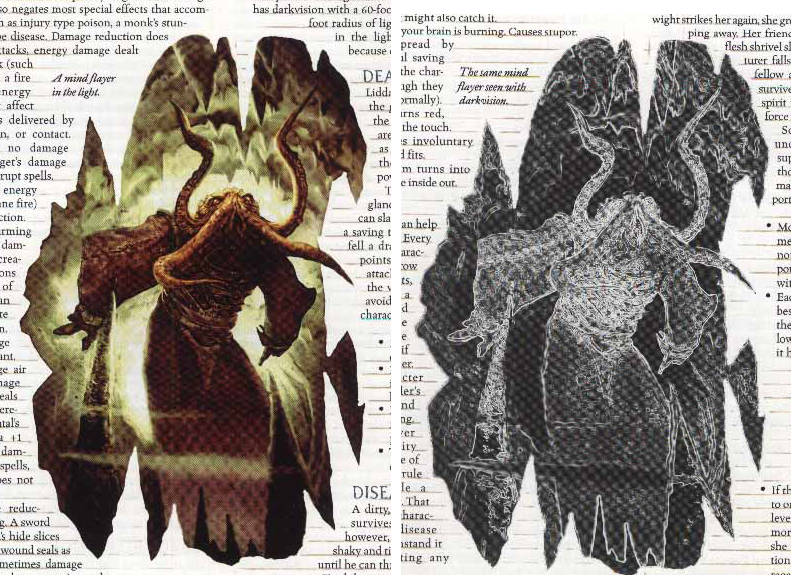
In prior editions of D&D, these things weren’t just rarer; they were also different in important ways. Elves didn’t have darkvision in D&D v. 3; they had low-light vision. They could see farther by starlight, moonlight, and torchlight, but they couldn’t see in the darkness. It was still a problem because they could see things others couldn’t, but it was different. Meanwhile, dwarves had true darkvision. It was black-and-white only, but in the original 3rd Edition DMG, it was described as this weird contour-only thing and illustrated thusly…
Go back to earlier editions, and demihumans didn’t have darkvision, but rather infravision. They could see heat. They had Predator vision. Predator as in the movie franchise, not predator as in the ecological niche. That was great for spotting living things, but it didn’t help much for inanimate objects and features. But the important part was that any amount of normal light spoiled infravision. So, if the dwarf or the elf wanted to scan for heat signatures beyond the radius of the party’s light, the party had to douse their torch or shutter their lantern. Effectively, it required every non-dwarf and non-elf to blind themselves. It was useful, but it was situational, and it had a tradeoff to take advantage of it.
So, where does all this leave us? What’s one to do with all of this? Is this just a rant for rant’s sake? Honestly, I don’t even really know. I often start these rants with no idea where they’re going or even if they’re going anywhere useful. And that’s complicated by the fact that I’m always of three minds on every subject.
My first mind is about the poor, bedraggled Game Master who’s just trying to get a good enough game out of whatever system they’re running. I just want to give them advice to improve their experience without asking them to rewrite the rules and gut the system. And, honestly, when it comes to vision, light, Perception, searching, and all that crap, D&D actually does work perfectly fine. I know people piss and moan about Passive Perception and that “I have darkvision” has become a community punchline, but those are actually really minor problems. They don’t break anything. All those Game Masters really need to do is to consider that the game terms Bright Light and Dim Light are crappy terms and adopt a bubble of crappy vision surrounded by blindness approach. Keep the details vague and require the players to examine things deliberately when they’re not in direct sunlight. Anything more than a spear’s length away is a menacing shape making ominous movements.
My second mind is for building better systems. I really do want to improve how we design and adjudicate traps. That means rethinking perception and searching. I didn’t realize how much I’d need to rethink those things until I started trying to outline shit. I’m now wondering if it might be worth just offering a comprehensive Better Vision, Spotting, and Searching hack before I even touch traps.
Would anyone want an improved way to handle perception, awareness, searching, and senses in general for D&D? Let me know in the comments.
My third mind, of course, is for my own in-development system. Because that’s a ground-up thing, I can basically build it however I want, and one of my goals is to do everything better than everyone else is already doing it. You know, nothing too ambitious. And that’s where I run headlong into the conflict between the best experience for the players and what I’m actually asking the Game Master to manage. Yeah, in theory, it would be great if everyone’s senses let them see different distances and different levels of detail, and if all features were described based on their precise distance from the party’s light source and all that crap, but that’s the sort of thing you ask of an NVIDIA GPU, not a human Game Master.
Likewise, although I always want the party to be afraid of being plunged into the darkness without a torch, I can’t ever let it happen. That’s just murdering a party.
Would love a Better Vision, Spotting, and Searching hack!
I’ll offer the opposite point of view, the perfect is the enemy of the good enough. Crappy area of shadows and menacing shapes surrounded by darkness is good enough for light. Go straight to the traps.
Yes I would as well
Ditto
Would the improved way to handle perception, awareness, searching, and such also be useful in other systems? I’m guessing yes, but even if not, I’m very much into it.
I have seen a lot of players who not only assume they have perfect vision as if in daylight, but they don’t even bother to care about light sources. When I start campaigns and players go in some dark place, I always describe de first room as barely illuminated by whatever light comes through the door that you just opened… Most get the implication and light a torch or somesuch spell, but for the first few sessions they keep forgetting to care about a light source, or forget who has the light source when they split or switch positions.
I am guilty though of describing things in detail once the light source issue has been solved.
Great article. I love the idea of increasing spookiness through vague visual descriptions when players use a light source. Maybe that could be coupled with more attention on sounds and other senses. I’d be very interested to read about handling perception, awareness, searching, and senses in general for a world’s roleplaying game.
I’ll dance for a Better Vision, Spotting, and Searching article!
Seconding on the Better Vision article. I could always use a better method because I could always use some help in making the darkness more of a threat rather than an inconvenience.
Currently, my dealing with light is binary, and I think it’s what the system wants. We got a party of heroes diving in dungeons with nightvision, lights and all. That’s their job so yeah nothing special to them, and that’s all good, there are real threats in there, monsters and traps. Light is only a real problem against special darkness spells that need to be dealt with and that torches and cantrips can’t break.
Now traps: they have a difficulty that should take into account the fact that they’re laid in dimly lit places.
Depending on the party actions and their rolls you adjucate whether they discover or trigger them.
The problem: are naturally dealt with by using the following DM trap user’s algorithm:
1) Set clues that there are traps: remnants of triggered traps, knowledge that whatever lives here uses traps, etc.. Don’t miss this one unless you want your players to become trap paranoid.
2) Look at your traps, there are 2 categories: immediate threats (direct dmg, and/or movement hindering effect: pits, puddles, saws…) and lingering threats (poison, chest traps, diseases, gaz..)
3) pick one or more of three ways to trap your dungeon:
– the Angry metroid way :
There’s some surefire way to detect them, then there’re encounters with “detected” traps in them that the players must work their way around. Immediate traps work best.
– the encounter magnifier: you need ennmies around immediate traps to jump on the party that just triggered it or to fight the party while enjoying the effect of the traps by pushing the party on them, or blocking exists with saws or pits for example. It can also work against the ennemies and help to run away.
– lingering traps can be set almost anywhere, if triggered the party has to spend some ressources to deal with the lingering effect or suffer it for the next encounters, these feel the most like screwjobs so don’t litter them everywhere, a lonely door outside the way, a chest that’s way too obvious, a room that’s a bit strange: make the place obvious, not the trap, that’s for the players to notice that something’s too easy. This way when they trigger it, they will blame themselves and won’t discuss mechanics.
And that’s about it. Can it be better? Maybe, but it hits a pretty good complexity/effect ratio as it is IMO.
Still I look forward to what you come up with, as always.
I enjoyed your summary here. I remember the screw job articles, but i couldn’t remember the traps in summary. So really helpful to see it laid out and how you implement things.
Vision article please! I always run into the exact issues you describe above, Angry, with my brain wanting to basically ignore that the PCs are in a spooky dark place and just spew full detail info at them at all times. I’m pretty sure the tone and mood of my games would improve dramatically if I could keep that crappy vision bubble surrounded by darkness thing in my head.
If we could get a “Dungeon Vision One Sheet” similar to what you’re doing with wilderness travel/encounters, that would be great!
I’d say that if you have a player who asks how their character could possibly miss something as “obvious” as a string stretched all the way across a hallway, you should set one up across your own hallway…right near the bathroom…after they go in to use it. Then you get to ask them. 🙂
To be honest, even though a Better Vision, Spotting, and Searching system is truly needed, I don’t actually care a lot for D&D hacks anymore, and would prefer to read more about your own take for your own system, Slapdash
Though I understand that Angry wants to help the DnD crowd, I left that system long ago. My own has been far better suited to the kind of game i want to run.
I really like this article. I’m always a sucker for object lessons for players and I think I have my next one-shot session idea (maybe Halloween?). A simple dungeon, mapped out on grid paper, played in the dark with only a (real) candle or two for light. Really focus on the atmosphere and limitations of vision as inspired by this article.
I’ve struggled with really similar questions. I’d be interested in your take on better searching.
I ran a homemade dungeon-crawl game for a while that attempted to facilitate different senses from the PC’s. While exploring, each round would begin with my basic description and the players all declaring actions. Then, before resolving the actions, I would sometimes add new information for player’s whose characters had special senses. If they had new information, they were allowed to change their action.
A memorable example of this was a character with a good sense of smell. The party entered a room and I described to everyone: “a large humanoid shape moves toward you quickly and quietly.” Many characters took aggressive actions. Then I described that the one PC who could was able to recognize the smell of an NPC they met earlier. The PC changed their action to try to intervene and stop the party from hurting their friend.
There were problems with the system, and I could never quite get it to be as smooth as it seemed like it would work in my head, but it still seems like it had potential.
When you mentioned the elves and the low light, that’s a pretty big thing too, is the darkness outside underneath a night sky, is there a window, or actual deep in the darkness-that-was-always-there type of catacombs. As if there’s any part that’s exposed to the sky, you can just spend a few minutes (non-Grue conditions providing) and get your eyes used to the dark, elf or not, won’t be as good but still.
Likewise with dark vision, if they’re walking next to the guy with the torch, they’re going to see as much (or slightly less, because those more acute finely tuned eyes will more easily get blinded) than the guy with the torch. If they want their fancy dark vision to work as intended, they ought to be going scouting alone ahead, or lag behind and check for details the others missed. This way, it’s easier to remember that oh yeah they have dark vision they should be able to pick out that detail the others missed, and you can swap narration between the scout(s) and the rest of the party, with the reminder built in. Plus you can maybe pull the old “Something just grabbed you and dragged you away.” And the rest of the party then comes to the spot where their scout used to be a few seconds ago and now they’ve gotta find him before tragedy strikes. Or at least cut them off from the rest of the party with goblins coming out of the fake walls in between them.
As for tripwire, the metal variant weren’t around until the 1800s I believe, so it becomes a case of: if they have the technology to make thin wires of metal why aren’t they doing this and that too? If the tripwire is just string, well that’s going to be less prenhensile strength to work with then I guess. It’s one of the reasons I hate dungeons, because things like traps can only really work through magic, otherwise things are going to rot away or break and what not (loot and any kind of furniture too, given enough time). Like the Egyptian tombs and stuff, those traps weren’t blowdarts in the wall and pressure plates, it was like a single stone pillar holding a big slab up kind of thing, that’s the kind of non-magical trap that would stand the test of time, and yet everyone’s go-to always seems to be Indiana Jones.
Interesting article – it’s a challenge that I have to remind myself to consider when I’m running games where it’s likely to matter!
The bit on darkvision did remind me of a fun one-shot I ran once. Due to a series of unfortunate circumstances that would take too long to go over here, I managed to wrangle a slot DMing a halloween-ish session in my group’s larger West Marches-style campaign. The pitch was that they’d be going into a cave which had been rigged up as a deathtrap by a particularly cunning Nilbog and his flunkies.
Naturally, since it was a 5e D&D game, all the player characters had darkvision. This was fine, I’d planned for it, and the trap gauntlets they had to pass through worked out alright. One fun thing, though, was that one player had brought a Gloomstalker, which has the ability “invisible to characters relying on darkvision”. This was mostly to their benefit… until, towards the end of the session, where the character got knocked unconscious in the middle of a dark tunnel – and all the other characters IMMEDIATELY lost track of them. Because the ability doesn’t say it turns off when that happens.
The party became increasingly panicked trying to work out how to find this invisible gnome in the middle of a tunnel that was rigged to hell and back with nasty traps they couldn’t be sure they’d see coming, and it took my pointing out that _they’re only invisible in darkness_ before one of the other players twigged and lit a torch, immediately making the character visible again. That scene still gets recalled fondly by the other players years down the line.
Vision article! Angry please post whatever your most passionate about. I’m very interested in your own system.
The major thing i wished this article went over was how to handle different types of vision. In my game, i only have regular smegular human vision. So I have the chance to open different types up eventually, and can do them in a way that is gm oriented. I do like the infravision cost, where you sacrifice to get the advantage.
I am also interested to see how you solve this in DnD. I don’t play it but the solutions often have applications across all systems.
I’ve come to realise recently that players really have been trained to expect perfect vision, and I’m probably guilty of encouraging it myself. I’ve recently been running a WFRP game. Elves in that game have night vision, like in older editions of D&D. It’s not a dungeon-oriented campaign, so they don’t spend a lot of time underground in darkness. Every single time they do go underground though, almost without exception, I have been forced to go through exactly the same conversation:
“I have Night Vision.”
“I know. You still can’t see in total darkness.”
Did DnD get rid of it because people were tired of this, or do we deal with this because DnD got rid of it?
Better perception – YES
Better traps – YES
Everything else – YES
Grues yes. Now I have to go dig out a zork emulator. Thanks for that.
Rest of it really was just a rant without a point (and I was hoping for some cool insight into running better traps).
Still, a couple comments. Darkvision in “some” systems turns dim light into bright, but not all, and not modern versions of “the” game. So, yeah in the systems where that’s not true (where it only turns darkness to dim black-and-white) what you have is 20′ of good light, 20′ of dim light, and +20′ of black/white vision for the darkvision folks. Manageable. Honestly, in dungeon crawls, a 20′ *radius* (so, 8 squares across) is going to light up most small to medium rooms (but not caverns, love me some caverns).
In “a system”, people often forget that dim light gives disadvantage on *all* perception checks, or a whopping *-5* to passive perception. This could go a long way to “shutting players up” if that’s your actual aim. Just make sure that when they ask to look around the room, make them roll with disadvantage. Do this a few times and they’ll get the picture that “s***, it’s hard to see in the dark!”
Another thing I’m surprised you didn’t bring up is the opposite effect of what you discussed. Namely, if I am a creature standing in darkness (because I have darkvision), and you are a party coming down the corridor 100′ away with a torch, I’m going to see you *just* fine. Because you lit yourself up like a giant beacon with a sign that says “kick me.” Use this to your advantage, also, but make sure your players *feel* the pain of that, so it becomes another reason to “fear the dark.”
“You hear some scuffling up ahead in the distance” or similar setup before they get ambushed out of the darkness by goblin bowmen that are 100′ away. That’s always a good time.
Cheers!
“The rest of it was just a rant… and I was hoping for an insight into running better traps.” … The title is literally “Y’all Mind if I Rant About Light and Vision?” Why the hell were you expecting anything other than a rant about light and vision? Did you think I was using reverse psychology?
Also, you’re going to see “a light coming.” You are not going to see “a party coming just fine.” See? You don’t know how eyes and light work either. You aren’t ready for better ways to handle traps.
If it makes problems, get rid of it.
If you really wanna keep Darkvision. make it a skill check players can employ when it’s dark. If there are light sources nearby like torches it interferes with their eyes.
Funny, even though I’m weeks behind still, this exact issue came up in our game last week. The party is traveling a long distance and camped for the night. Two party members that can fly went scouting ahead near dusk. They stayed out too long thinking, “Oh, I have Darkvision. I’ll be fine!” Unfortunately, that night was a Waning Gibbous moon that doesn’t even rise until 3 hours after sunset… and the PCs were flying higher than the range of their Darkvision, so they lost sight of the ground and got lost. (I didn’t set that up, the players failed to account for the lack of light, pushed their luck on how far ahead to scout, waited too long, and then failed multiple checks to navigate back to the rest of the group… and have no magical means of communicating with them to even let them know they’re lost… and I’ve warned them about light issues in the past)
I for one would LOVE to read a better way of handling “perception, awareness, searching, and senses in general for D&D”, even though I don’t even own the latest version of one of the world’s Role Playing Games. (heck, I don’t even have the two versions that came out before it!) I’m not even running D&D right now, but I’m willing to bet that whatever you come up with will be AWESOME! (because you’re just that good ;^)