

This feature is part of my ongoing course in advanced adventure, encounter, and campaign design, True Scenario Designery. If you haven’t been following it from the beginning, there’s a course index you can use to catch up.
This lesson continues a long-ass section about scenario structure.
Everyone Shut Up; I Have a Headache
What the hell are y’all doing here? Is there a class today? Shit.
It’s fine. Come in. Sit down. Shut up. I’ve got this. Kind of. I even have visual aids. If they look like crappy sketches I literally ripped from my own, personal design notebook, that’s because I’m making a clever point about how design is messy and haphazard and you can’t be distracted with aesthetics and polish at this stage of the game. Yeah, that’s it. It’s a clever point and has nothing to do with my being too much of a lazy-ass to make better graphics.
I’m not even going to crop my notebook pages and take off the tags and dates. Again, I ain’t being lazy, I’m making a deliberate presentational and stylistic choice to support my central themes.
Actually, let me be honest with all of you aspiring scenario deseñors and deseñoritas: I had a really hard night. That’s why I look like hell. Drinking? I wish it were drinking. No, I spent hours rebuilding roleplaying game combat engines in front of an audience. You members of Club Slapdash know what I’m talking about. Especially those of you who were dumb enough to hang out for three extra fucking hours after the official performance ended to shoot the shit about depression, marketing, Rick and Morty, and whatever the hell else we talked about. I don’t remember most of it.
Anyways…
Structure. Scenario structure. That’s where we’re at, right? I already explained what structure is and I showed you the basic roleplaying game scenario design structural hierarchy last time, didn’t I? That shit about nesting campaigns, arcs, adventures, scenes, and encounters? Which means we’re talking about scenario shapes now. So let’s do that.
The Shape of Adventure
A few lessons back, I told y’all that shape is one of the essential components of gameplay structure, right? Please tell me you remember that shit because I am not in the right mental space to be recapping shit.
Actually, maybe a recap would do us all some good. Let me do this by way of analogy.
Imagine you have to write something. Maybe you have to write a few thousand words explaining advanced adventure and game design to publish on the blog you’re still inexplicably running in 2025. Well, when you have to write something, you usually start with an outline, right? Yes. You do. Look, I know no one writes things anymore because we have ChatGPT, but trust me here. When you have to write something, you make an outline first.
An outline’s just a list of the ideas you’re going to present in the order you’re going to present them, right? It’s basically just a map of the thing you’re going to write. Well, if you look back at everything we’ve been doing with this predesign shit, I’ve actually been teaching you to outline your scenario designs. Consider what I taught you last time about scenario hierarchies. Don’t outlines show the hierarchical relationships between ideas? There are big, honking main headings that become the chapters or acts or whatever, and there are smaller headers for the different sections, and there are tiny little bullet points for the individual paragraphs that each contain just one single idea.
In fact, all those examples I’ve been spitting at you about shitty goblin cave adventures and treasure-filled ruins? Those are all just scenario outlines.
So outlines show you how your writing flows from one idea to the next and how those ideas relate to each other hierarchically. Makes sense, right? But outlining is actually a pretty crappy way to design most scenarios, and this is where I introduce the concept of scenario shapes. Outlines are really great when you move from one thing to the next in a linear fashion. It’s great for writing — or for linear-type adventures — when ideas flow from one to the next, but that’s not always how roleplaying game scenarios work, is it?
There are indeed linear roleplaying game scenarios — and this is where I remind a bunch of you screaming dumbasses that it’s not only perfectly okay to build and run linear scenarios but that it’s sometimes the best way to run a scenario. Sometimes, the players are just walking the road between the town and the dungeon and having road encounters on the way. Sometimes, the players have to fight their way through three waves of minions to confront the commander and his elite guards. In those cases, outlines work.
There are times, though, lots of times, when the players get to make choices. Choices are a central part of the whole role-playing gaming experience thing. The players get to choose which road to take or which door to open or which site to visit in a complex or even which goal or adventure to pursue.
There are also times when the players’ previous actions determine how they can move through the scenario. Maybe one of the doors is locked and they can’t enter it until they’ve found the key elsewhere in the dungeon. Maybe they can’t get into the basement nightclub without earning a favor from the crime boss. Maybe they can’t visit the nightclub because they don’t even know it exists. It’s just one of hundreds of unmarked doors opening off the maze of alleys in the city.
There are also times when one scenario’s outcome determines whether the players can travel to another. Imagine, for example, that the giant is approaching the village and the players ambush it in the hills. If the fight goes well, the giant flees back to its lair and the players can confront it there for a final battle. Meanwhile, if the fight goes poorly, the players have to pick their broken asses up off the ground and confront it as it stomps through the village. At least the giant will be distracted stomping villagers like Smurfs as they desperately try to defend themselves.
“Well, thank you so much, Angry, for explaining the concept of a frigging flowchart to us smooth-brained peons. Literally none of us here in your so-called advanced course on adventure design ever considered using a flowchart when designing roleplaying game adventures. You have changed our gaming lives forever with the above thousand words, every one of which was worth reading, even the swears words. Please link your support page so we can give you all the money and tell me what tier of support grants me the honor of you fathering my children.”
Wow.
First of all, I already made it clear that I’m not in the mood for your shit today. Second, you can learn more about supporting my work at https://theangrygm.com/support-theangrygm-com/. Third, what makes you think you’re worthy of mothering my sexy gaming genius offspring? Especially with you missing the point that frigging hard.
Believe it or not, this isn’t about flowcharts. It’s not even about outlines. This ain’t The Alexandrian and I’m not going to pretend, “What if dungeon map, but we call the rooms nodes and make them events,” is some revolutionary fucking idea. Sorry, Justin, you didn’t invent flowcharts or event-based adventure design.
Sorry… that wasn’t nice. I’m in a really shitty mood today and that jab was uncalled for. The Alexandrian is actually a great site. Plus, I gotta respect the only other dumbass in the space who still thinks people actually want to read gaming content instead of watching YouTube shorts. I’m just kind of sick of everyone screaming node map at me every time I talk about diagramming adventures.
Anyway…
Let me tell you the secret, stealth lesson I actually just taught you while I was pretending to explain why flowcharts are better than outlines.
Surprise, You Grok Shape!
Obviously, scenario designers don’t stop at outlining. They draw maps or flowcharts or node maps or diagrams or timelines or whatever. Even mere adventure builders do that shit. It ain’t news to anyone. Neither is it news to anyone on this site that all those things are exactly the same as each other. A node map is a dungeon map is a flowchart is a timeline. The difference there is strictly in what gameplay the blocks represent. Sometimes they’re encounters, sometimes they’re rooms, sometimes they’re rooms with encounters, sometimes they’re events, sometimes they’re objectives in a heist, sometimes they’re characters in an intrigue plot and sometimes the lines are hallways and sometimes they’re clues and leads and sometimes they’re favors owed and sometimes they’re logical conditionals.
That shit doesn’t matter. To see what matters, we have to zoom out. Remember, this whole course is about top-down adventure design, right? It’s about making adventures that are more than just strings of encounters or rooms or events or nodes or whatever. It’s about macroscopic challenges and macroscopic design.
Consider some of the examples I snuck into the above talk about outlines. For example, consider that road to the dungeon thing. In that scenario — probably a scene in an adventure — the players walk along the road dealing with one obstacle after another. The major element of challenge — the macrochallenge — is about surviving all the obstacles so you can explore the dungeon. Or maybe it’s about conserving resources so you have enough to face the dungeon.
Now consider that ambush the giant encounter. That had a couple of different outcomes, right? Maybe the players defeat the giant. That’s really unlikely because the giant is powerful enough to wear down the players before they take it down unless the players do something brilliant. But the players can do enough damage to send the giant limping back to its lair before they’re spent and then follow it home and confront it with an advantage. Or the players might run out of steam with the giant still kicking and so it leaves them behind and stomps off to squish the village and the players have to chase it. That whole setup feels very different from a linear string of encounters, doesn’t it? And it lends itself to different plans and strategies, right?
I mentioned some maze-like dungeons and maze-like mysteries, didn’t I? Those are scenarios through which the players get to wander on their own initiative. The challenge is usually about finding a path to the goal or accessing the initially inaccessible or some shit like that.
I also mentioned a complex with multiple sites to explore. Imagine, for example, a ruined abbey with three or four different buildings opening onto a central courtyard. The players can delve into the buildings in any order or even get partway through one and then return to the courtyard and tackle another. That’s different from a labyrinth, isn’t it?
Can you see how there’s some fundamental difference in how it feels to play through those different scenarios as well as in the macrochallenges that work best in each? That’s all down to nothing more than how the action flows from element to element. That is what scenario shape is all about and why it matters to talk about. That’s what scenario shape actually is.
You now get scenario shape on a deep, experiential, intuitive level. Which is the best level at which to understand anything.
Aren’t you sorry you were such an asshole about flowcharts and node maps now?
The Six Shapes of Adventure. Or Seven. Or Maybe Five. Or Really Infinity.
Man, the rest of this lesson’s going to be so simple. Hell, I could probably just throw up my purposely crappy and not-lazy-at-all visual aids and call it a day. This whole shape idea is actually really simple. The way you connect up the elements of a scenario affects the gameplay experience and certain patterns of connection yield certain kinds of experiences and it’s useful to be able to talk about those patterns. Broadly speaking, that’s all there is to this shit. But I promise you that this shit only seems simple and shallow. Over the next several weeks, you’ll see just how deep this rabbit hole really goes, even though this basic idea is pretty simple.
Before I show you a crappy diagram, I want to draw attention to my characteristic vagueness. Notice that I’m talking about broad patterns. Notice that I haven’t provided a firm, solid, clear verbal definition of shape. Notice how I’m unsure how many shapes there actually are.
I am not being definitive or categorical because that’s not how this shit works. Bright lines and hard categories and firm definitions are terrible things that you shouldn’t ever do because they limit your design. This crap is purely description and you have to stand back and squint and I am never going to stop reminding you dumbasses that that’s how it is. Nor will I stop swearing at and insulting you every time you try to pin this shit down.
So, I’ve got this diagram I made of what I consider to be the six basic, general shapes of adventure. They’re just six patterns that most scenarios tend to fit. More or less. But I need you to understand I could have drawn as few as four or as many as seven. I also need you to understand that there actually could be dozens or hundreds. This ain’t a definitive list and these aren’t checklists or recipes. You absolutely should not treat them as unbreakable rules.
For example, maybe you decided that the travel the road scene in your adventure should be linear. That’s a good choice. But just because you decided that doesn’t mean it has to be perfectly linear. You can add a little optional side thing somewhere. You can add a single branch or loop in the middle. It’ll still have the feel of a linear scenario, but it won’t match the Definitive Angry Diagram of a Linear Scenario anymore.
That’s okay. That’s how this works.
Anyway, six shapes. Here they are…
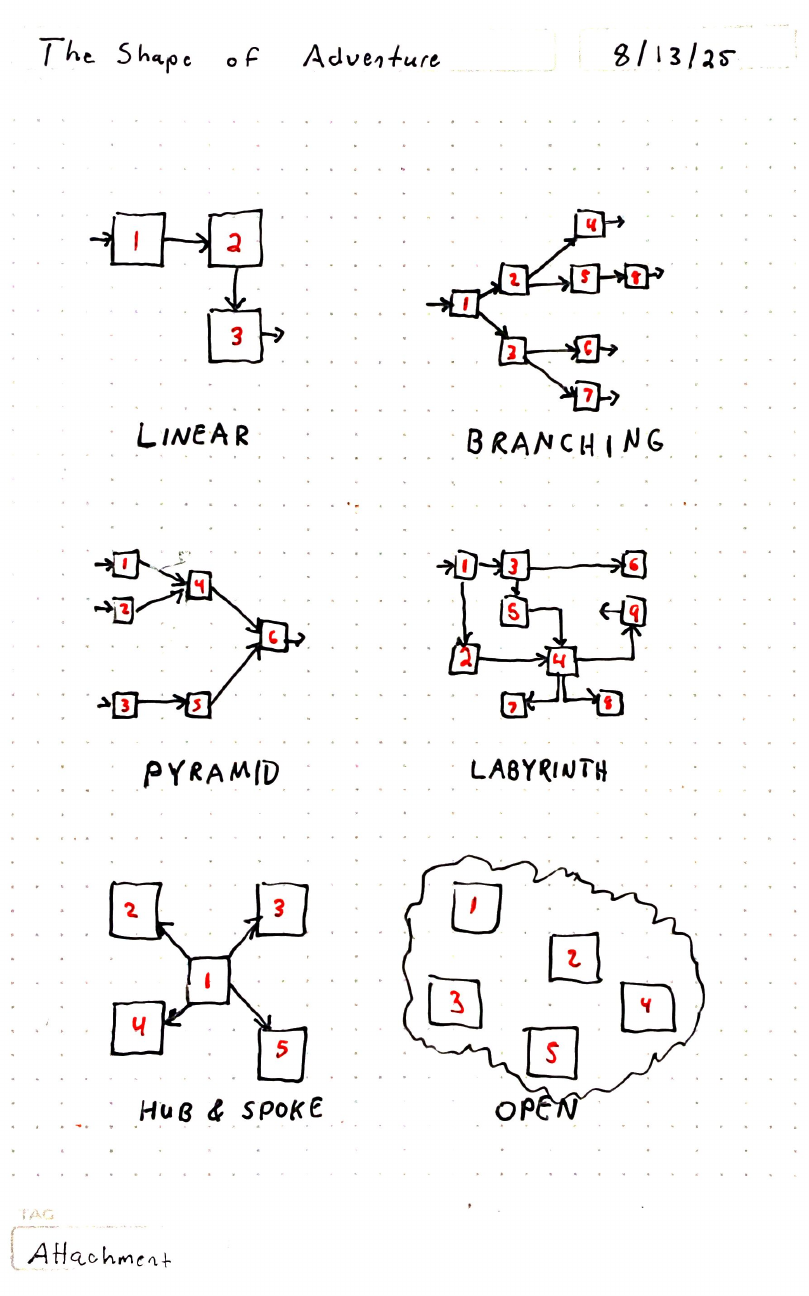
Those little crap diagrams say it all, really, don’t they? There’s not much to explain, is there? It’s all pretty obvious, isn’t it? I mean, there’s an extra layer I’m gonna add with two more self-explanatory diagrams, but there’s barely anything here worth explaining. Even so, I’ll run quickly through the shapes and make a few minor bonus points.
Linear scenarios are easy enough to understand. They’re just strings of elements in sequence. Maybe they’re encounters on a road or maybe they’re events in a timeline as the heroes stay in a haunted inn for the night. Whatever. The action starts at one end and progresses through to a conclusion. The outcomes might depend on how the players handle the events or when they exit the linear sequence. Which is something we’ll talk more about in future lessons.
Branching scenarios are also simple. Each element has a few different links and each leads to new elements so the gameplay spreads over time. The outcome usually depends on which exit the action gets to. That giant ambush scenario is a great example of a branching scenario. The initial encounter has two outcomes — rout the giant or fail to stop the giant’s advance — and each outcome leads to a different climax — slay the giant in its lair or join the townsfolk in defending the village. Branching scenarios are best kept small, though, because they necessarily require building a lot of content that’ll never see the light of play and the number of outcomes can balloon uncontrollably. There are ways to handle that, though.
Pyramid scenarios are just branching scenarios in a mirror. They start with lots of possibilities and converge to a small number of possibilities. Mysteries and intrigues tend to follow pyramid structures. There are lots of initial leads or interactions and gradually the players work through to a couple of possible final climaxes or outcomes.
Now, let me show you what I meant when I said there could be five or seven or four or infinity diagrams on this page.
When you consider stacking two scenarios in sequence — which I’ll describe below — pyramid scenarios and branching scenarios tend to fit very well together. Imagine an adventure with two different scenes. The first scene is a branching scene and spreads out to a lot of different outcomes. The second scene is a pyramid scene where the outcomes become the inputs. Over the course of those two scenes, the action first diverges before it converges to a climax.
I should have drawn a diagram. Wait. Let me slap one together quick-like.
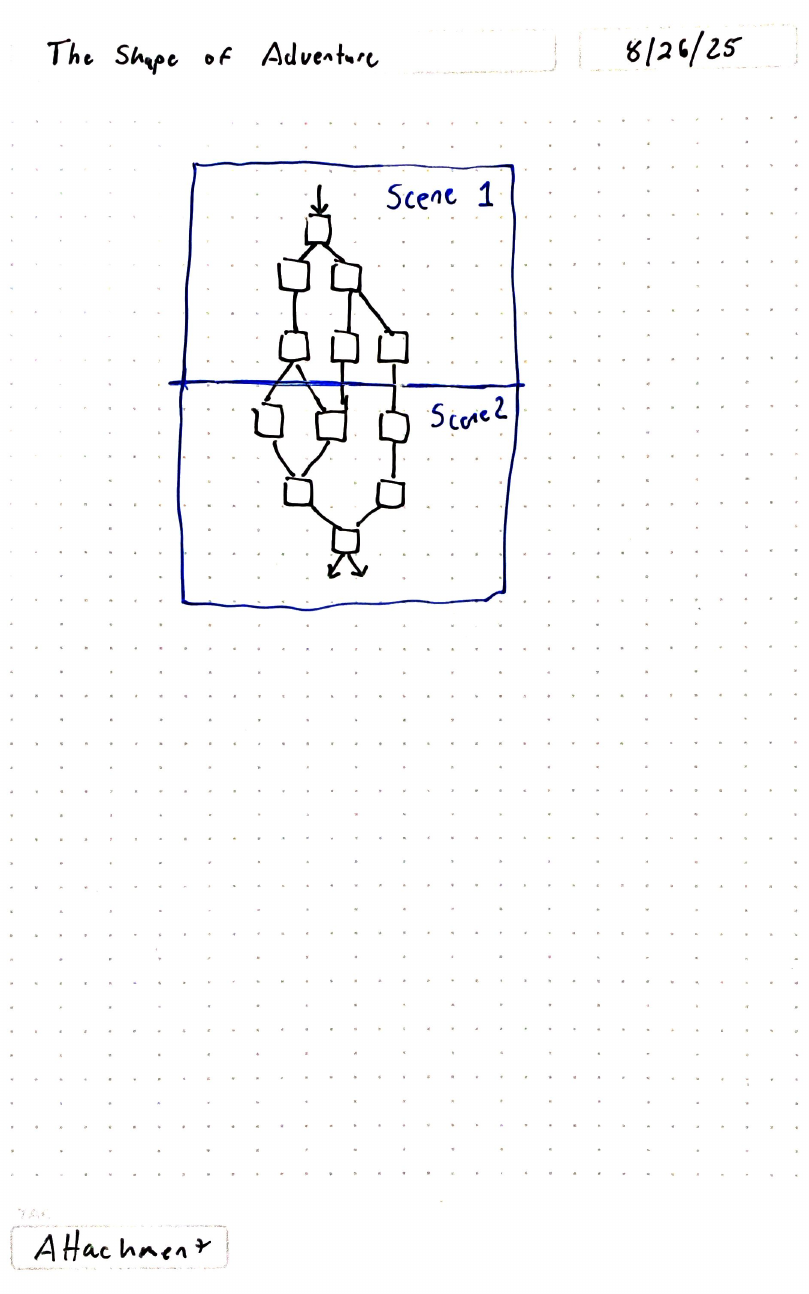
Bam. Not bad, huh? Anyway…
Hypothetically, I could have called diverge-and-converge a shape of its own. Then I could have had seven shapes. But it’s also worth noting that once you combine the branching and pyramid shapes like I did, it’s basically just a labyrinth with one-way linkages, and so the issue is more about scenario flow than scenario shape, but that ain’t a discussion we can have yet, is it?
Labyrinths, by the way, are classic dungeon shapes. All the elements are linked and interlinked and the action meanders around trying to find one of the outcomes. This also covers node-map style adventures and some kinds of mysteries and intrigues.
You probably spotted, by the way, that I drew little exit arrows in some of the diagrams to represent outcomes. Don’t take those arrows as definitive requirements of the shape or anything like that. Hell, I forgot to include outcomes in some of my diagrams, and sometimes you can’t really put an exit arrow anywhere. We’ll talk about outcomes in scenario structure in the future. For now, just know outcomes exist and they can be plotted on these diagrams, but sometimes they can’t, and there may be several accessible from different elements, or a couple accessible from one element, or whatever.
Don’t be definitive. Don’t overthink. Everything I’ve already taught you continues to apply.
Hub-and-spoke scenarios are also pretty straightforward. You’ve got a central scenario element that connects to a bunch of other elements and the action tends to move out into the spokes, then back to the hub, and then into different spokes until an outcome is reached. That ruined abbey I described? That’s a good hub-and-spoke setup. Or maybe imagine one of those gain the respect of the town adventures where the players run around meeting different townsfolk and each has a little favor or mini-adventure or sidequest for them, and when they’ve made enough people happy, they reach the good outcome.
This is another spot where things get fuzzy, right? I mean, a hub-and-spoke scenario is really just a labyrinth with a central location. Imagine, for example, there’s an ancient vault with a sealed treasure in the main room. To access it, the players have to walk three different challenge paths to prove their worth or some shit like that. After each path, they return to the central room and start a new path. Really, it’s the repeated returns to a central location that make such an adventure feel like a hub-and-spoke setup instead of a labyrinth which shows again how shape isn’t the be-all and end-all of structure and why we still have to talk about flow and progression.
Speaking of shit I could call hub-and-spoke…
In open scenarios, the elements are kind of free floating. They’re like little islands in a sea and the action can sail from island to island freely. Traditional hexcrawls are basically just open scenarios ruined with a terrible scavenger hunt, forced mapping mechanics, and random encounter tables instead of game design filling the void between the actual gaming fun. On a less crappy note, most roleplaying game towns are open scenarios — when they’re scenarios at all, that is — because towns are just a bunch of locations the players can freely access, floating like chunks of beef in a stew.
The more alert among you — that obviously excludes any of you dumb enough to hang out in the Slapdash clubhouse until after midnight last night — the more alert among you have probably noticed that hub-and-spoke scenarios are just open scenarios with the hub replaced by a puffy cloud around the spokes. Which, again, comes more down to gamefeel than any objective diagrammatic reality. It’s all down to whether the in-between soup or sea or whatever deserves to be called a scenario element or not. Some of you might instead note that an open scenario could be easily represented as a labyrinth with lines connecting all the elements to each other.
Yep, you’re all right. This is more vague gamefeel bullshit, which is why I keep desperately pleading with you not to constrain yourselves by the technicalities of the diagram. I’m begging you all to please stop with the definitive, categorical crap. Especially in my supporter Discord. I’m actually getting tired of screaming and ranting and cursing at all y’all, even though it’s all for your own good.
But moving on…
If Every Element is a Scenario…
If you reread my long-ass rambling discussion about the elements of gameplay structure from two lessons ago, you’ll note I identified three such elements: shape, flow, and progression. Obviously, today’s lesson is all about shape. It’s all about what your scenario outline — the map or list or flowchart or node diagram or whatever — actually looks like and how that affects the gameplay feel of it all.
But do you remember what I taught you last time? Remember all that shit about how scenarios are hierarchical and that bigger scenarios are made of smaller scenarios and how there’s campaigns and arcs and adventures and scenes and encounters and all those things count as scenarios and so on and cetera and nauseum?
If that’s true — and it is or I wouldn’t have said it except that I lied and we’ll get to that — if that’s true, then every different level of scenario has an outline and every outline has a shape and each of the little boxes on those outlines is itself a scenario and has outlines and each of those outlines has a shape.
Well, that is how it be.
I’ve been pretty careful in my examples to focus mostly on scenes and adventures so far. It’s just easier to think about this crap in those terms. I’ve mostly talked about adventures that consist of a couple of numbered scenes that play out in a sequence. The scenes themselves are the bits with the flowcharts, and the elements of those flowcharts are just point-like encounters.
Basically, I’ve mostly had you thinking about adventures like this…
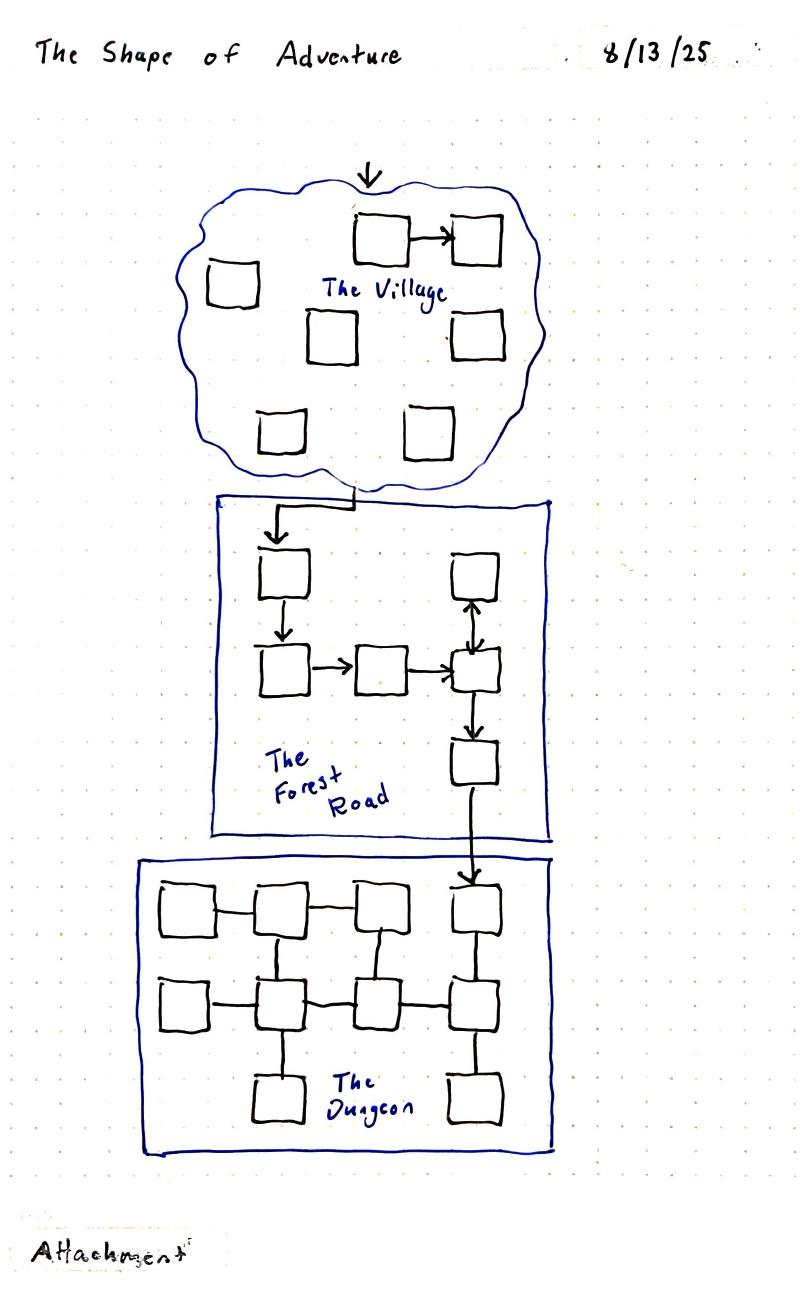
I probably don’t have to explain that diagram at all. You understand exactly what’s going on there, don’t you? You can puzzle it out.
But, it’s Kuato time, kids. I need you to open your minds. I need you to consider that these structural outlines work at every hierarchical scenario design level. For example, consider how I might diagram the ruined abbey adventure I described above.
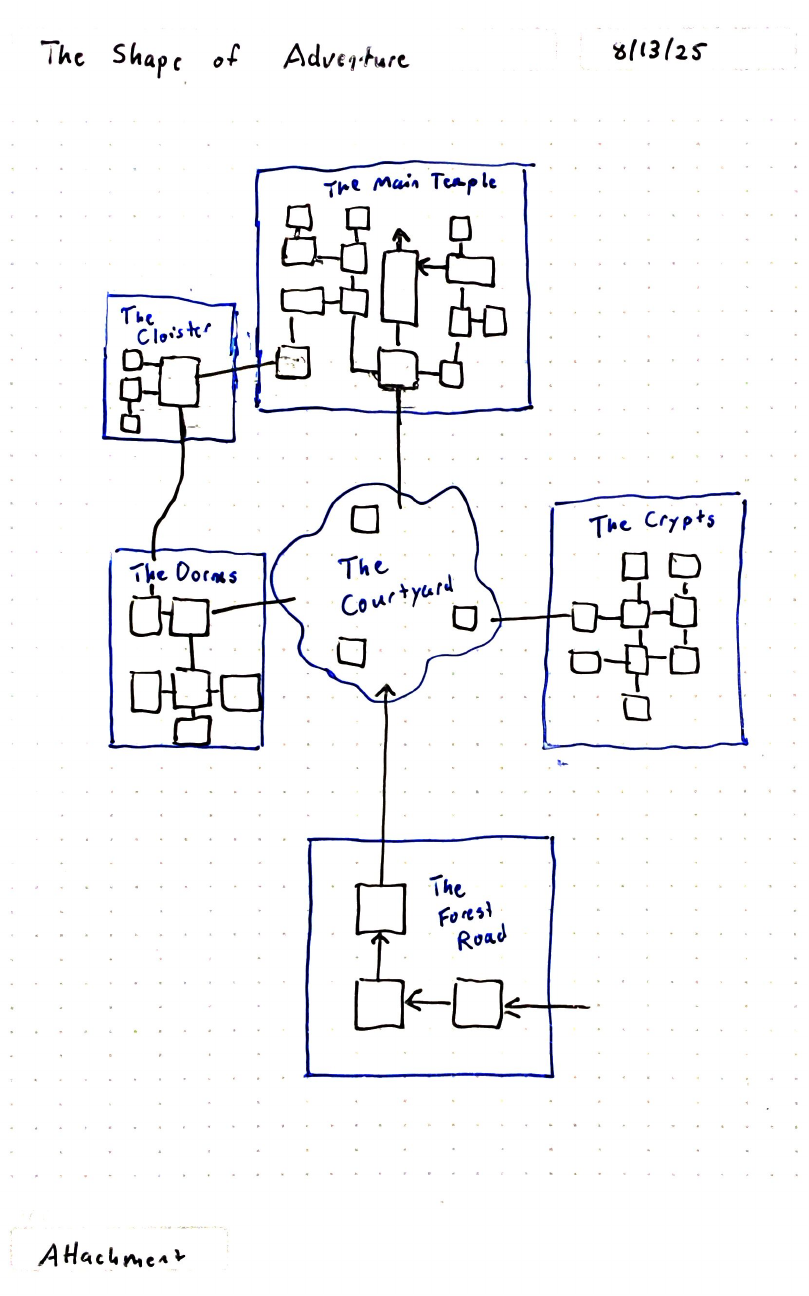
Take a good, long look at that shit. You can probably tell exactly what’s going on there, right? It’s pretty clear. That’s partly because I’m really good at diagrams — even lazy-ass scrawls I drew weeks ago fully intending to turn them into actual, good diagrams and then didn’t — but it’s also because you’re starting to grok this structure shut on an intuitive level even if you can’t put it into words.
How might we describe this scenario? Well, first, it obviously depicts an entire adventure. The adventure contains five scenes, but they’re not sequential storytelling-type scenes like we’ve been talking about so far. Instead, they’re more about spaces than acts in a script.
You can see the hub-and-spoke shape I described above, but it isn’t a perfect hub and spoke. The Courtyard Scene is a hub, and The Dorms, The Main Temple, and The Crypts are spokes. But there’s also a lead-in linear scene along The Forest Road to get to the hub. And there’s a shortcut scene between The Dorms and The Main Temple called The Cloister, too.
Hopefully, you can tell by imagining this adventure that it’ll have the feel of a hub-and-spoke scenario even though I did break the shape a little bit. That’s that gamefeel shit I keep talking about. The shapes don’t need to be perfect. Hell, the adventure above with the town, the road, and the dungeon has a couple of broken shapes too. Did you spot them?
Anyway…
The different scenes have shapes of their own. You can describe The Dorms, The Crypt, and The Main Temple as labyrinths. Meanwhile, the Forest Road is a linear gauntlet, and the Cloister has its own miniature hub-and-spoke thing going on. That makes sense given what a cloister is. The Courtyard, meanwhile, has an open structure to it. There are some free-floating encounters in there plus exits to the other scenes.
Oh, shit, let me slap together another hasty scrawl to make a fine point y’all can discuss in the comments. Assume I had the same setup, but I diagrammed it like this…
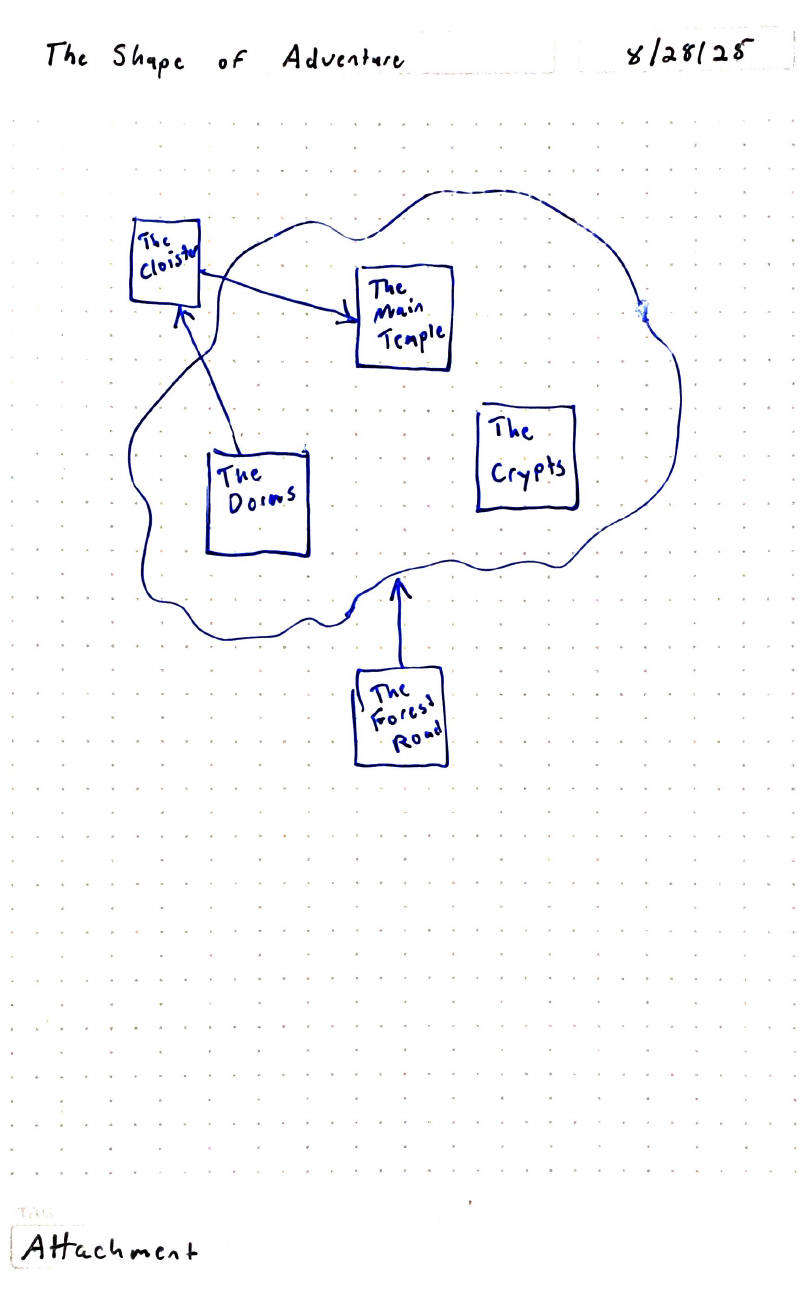
What’s the difference? What does my choice to depict the Courtyard as an open scene instead of treating the adventure as an open adventure with the buildings as scenes imply? Comment your best guesses. I swear I’ll be nice about them as long as you don’t say anything stupid.
Putting aside that bonus point discussion, there are a couple of key takeaways here. The first is that you can outline the structure of any level in the scenario design hierarchy and give it a shape of its own. Adventures can be linear sequences of scenes or open-ended scene soups. If they contain scenes at all. The arcs in a campaign can be a labyrinthine maze of adventures or just a straightforward sequence or an open sea of adventure.
The second point is that every little box on each of those outlines can be expanded into an outline too. It can have a shape. The little boxes in your scenes can contain linear encounters or open encounters. The adventures in your campaign outline can be branches or pyramids and the scenes in those adventures can be hubs-with-spokes or linear gauntlets and the encounters themselves might be branching encounters or pyramid encounters or whatever.
Any of these diagrams is just an arbitrarily chosen zoom level. If I erased the labels from those diagrams, I could say, “Here’s the outline of my campaign,” and then the big, blue boxes become adventures, and the black boxes could easily be scenes or encounters. Or the blue boxes are arcs, and every black element is an adventure of its own.
Consider that, in the end, a roleplaying game is just a series of encounters played one after the other, right? If you really wanted to confuse the shit out of yourself, you could, in theory, draw a single giant-ass diagram of all the encounters in an entire campaign on one giant piece of poster board, starting from “Meeting in the tavern” in the lower left and ending at “And lo they defeated Asmodeus” in the upper right.
I’m not saying you should do that. Just that you could. If you were willing to ruin your ability to design a good campaign, that is.
See, all this shape and hierarchy and structure shit just gives you a way to think about — and plan out — how your design choices affect the gameplay experience. Because, unless you’re a dumbass or you skipped the first half of this lesson, you intuitively feel how these shapes lead to different experiences now.
This stuff also gives us a way to communicate about design. Which is very useful if, say, a sexy gaming genius is trying to teach a bunch of mere adventure builders how to elevate their craft. Thanks to these past few lessons, I can now say something like this…
When I designed my Chain of Stars, I wanted to emulate the top-level scenario structure of Legend of Zelda: A Link to the Past and Dark Souls, but in three acts rather than five. Thus, I broke the campaign down into three arcs. The first would present a linear gauntlet of adventures that establishes the campaign’s major threat. The second — and longest — arc would be an open arc wherein the players would gather the resources they need to confront the threat from sites around the kingdom. The third and final arc would be a linear run-up to the final confrontation with the threat. Most of the adventures, especially in the second arc, would feature a labyrinth as their setpiece scenes because I mostly wanted to focus on dungeon crawling, much like A Link to the Past and Dark Souls.
Now that you and I speak the same language, you can probably picture my outline in your head, and you can even intuit some things about the gameplay feel.
At least broadly…
Warning: Incoming Recontextualization
I already warned you above that there’s a lot of complexity hidden beneath these deceptively simple ideas. Structure is more than shapes within shapes. There are still the broad concepts of flow and progression to contend with. After all, where you put the boxes on the map is only part of the design. You also have to decide what goes in which box and top-down design means understanding that every decision affects every other. We ain’t doing hexcrawls and kitchen sink Gygaxian dungeons with Jayquayed maps here. We’re designing real, actual gameplay experiences.
Then, too, the fine details actually matter. I know I said the overall shape is the same even if you add some side bits and breaks — and that’s true — but the fine decisions about which branches lead to what and how many branches you have and what connects to what in your labyrinth also matter. That’s where we start discussing specific shapes and techniques like building loops, gating, planning critical paths, and that kind of crap.
In short, there’s still a lot of structure to talk about.
But before we can talk about any of that, I have to go back and correct a tiny little lie I told you to make it easier for you to learn all the shit I’ve been teaching up to now. Remember when I said everything is a scenario and every scenario has goals and challenges and structure and outcomes and all that crap.
I lied.
But that’s a story for next lesson.
Depicting the courtyard as an open scene instead of treating the adventure as an open adventure with the buildings as scenes. On the surface these seem practically identical. In both the open courtyard scene and the hub-and-spoke setups, the various buildings can be accessed in any order. What FEELS different to me, is that the hub and spoke setup seems to imply that there is a specific and solitary path or means of access to each of those other scenes, while the open courtyard setup feels like it is implying that there may be more than one way to get into the other areas/scenes. Also, in the hub and spoke diagram, there seem to be three encounters in the courtyard and the placement of those encounters near the spoke lines to the other scenes seems to imply that something must be dealt with in order access the other scene/area OR that something happens in the courtyard when the PCs enter the courtyard after finishing a scene/area.
I think the difference between having the courtyard as it’s own open scene Vs having the adventure as it’s own open scene will affect how the courtyard is presented in the minds of your players.
By having the courtyard as an open scene with encounters in there it brings it to the forefront of the players mind as they go stomping about doing whatever the hell they normally do. Meaning they ‘should’ remember it more when they finish in one side building and need to go back to it when they need to visit another building to progress.
Whereas having the adventure as an open structure as a whole means that the courtyard sorta disappears into background description and it makes it harder to make encounters in there as the whole adventure sorta takes on this feeling of being in a ruined abbey.
He lied?!? How will we ever learn to trust him again!?
Seriously though, I like the info you’re massaging into my noggin, and look forward to the thrilling conclusion to the story next lesson.
I hope the structure with the Courtyard as an explicit hub is going to feel different to run and to play. The Courtyard as hub gives the players a kind of forward base to return to, somewhere they might feel a bit safer than in the other locations. There might even be some narrative structure there; after a climax in another location I might narrate/encourage/create some falling action and wind up the session with the PCs back at the courtyard. The hub-and-spoke also encourages me to narrate the Courtyard as a place with enumerated exits that can be explored—and when you’re done, you’re done.
The open structure looks more nebulous. I don’t see anything that communicates to the players that there are three things to explore, not four or two. They have to go out and find what there is to find. It may not be obvious to them if they have found everything. And there is no safe place to retreat to between excursions.
At least at first glance, that’s how I’d try to run the two structures differently.
I see the difference between the Hub courtyard and the open courtyard as whether or not the courtyard itself has enough relevance to be a scene of its own. In the open structure, you’d probably go straight from one building to another with maybe a small narrative transition of the first couple times the players move through the courtyard. Nothing of relevance happens there. In the hub courtyard, however, the courtyard acquires more relevance. There will probably be encounters in the courtyard, the courtyard may change itself after each of the building-scenes is completed, and it will stop being just a “hallway” of transition between one building and another, into a fully fledged “room”, even if it’s an empty room.
I think the whole point of having the courtyard as an open structure Vs the adventure as an open structure comes down to game feel and how the players remember it.
The courtyard having an open structure with encounters in there brings it to the forefront of the players mind and helps them remember it. So when they finish in one of the side buildings they should already know to head back to the courtyard and proceed to another building without you having to tell them.
Whereas having the ruined abbey as an open adventure means the courtyard sorta fades into background description which the players might completely gloss over and so hit a wall when they finish clearing one of the buildings and see no obvious way forward.
Obviously the players might ‘acknowledge’ the courtyard and focus on the 3 buildings in front of them but the courtyard as a scene in and of itself becomes lost.
I can’t wait for him to show me how to combine the shapes of a scene with Momentum and Inertia
Asking my crush what her favorite adventure shape is, then feeling catastrophically sad when she stops texting me back.
Thank you for the article! It’s yet another example of something that seems obvious in retrospect but really helped me think more deeply about how to make my game better.
I needed to run a wilderness adventure tonight. I hate running wilderness adventures, I just can’t seem to get the hang of them even with all your excellent articles about them. But this article clicked. So I took my amorphous open wilderness scene full of “what do you do now?” and inevitable blank stares from the players. I turned it into a labyrinthine node-based adventure with clear landmarks/features to mark each node. I made a few notes about how difficult it is to pass between each set of nodes by various means. I filled the nodes with hidden clues to help tell clever players if they were on track or not and where danger might lie. I added a few unique descriptions of the environment and the creatures within it to help bring each node to life. I basically rewrote the entire adventure in less than an hour on a single page of notebook paper. It was just a crappy diagram and some bullet points. And it worked! It felt so much better to run than my previous wilderness adventures. The players seemed engaged, had ideas about how to proceed through each area and where to go next, investigated parts of the world they never would have normally interacted with, and generally seemed to have a good time.
I can’t wait until the next lesson.
This is cool, and I felt similarly about wilderness sections. Your solution reminded me of the Hat DM or whatever his name is with the human familiar. Taking the shapes lesson from Angry, the Hat DM essentially turned his travel sections into a linear scenario, with choices earlier in the scenario affecting the encounters in later parts of the scenario.
Wrapping my head around all of this is really cool.
Yes. Hold onto that. Because there is a secret here in how to run better Wilderness Scenarios.
Brisk gut-feel from comparing the two diagrams, and roughly 0 seconds of thought, I get the sense that:
– In Diagram A the Courtyard is the safe space. In Diagram B the Road is the safe space.
– In A, the adventurers could very easily walk straight in off the Road and into the Main Temple, just by virtue of it being the biggest building. B implies instead that the more obvious/preferred/only route would be to enter the Main Temple via the Cloister.
– In A, it feels like the adventurers would have the opportunity to rest and recover between each of the Courtyard/Dorms/Cloister/Main. In B it feels like once they enter the Dorms, they’re buckled in until they’ve cleared the Main Temple.
– In both diagrams the Crypt feels like a bonus optional extra. Somewhere you can trade excess player resources (spell slots, per-day abilities etc.) for loot and XP. Maybe some low-impact story fluff.
All of that could just be incidental subconscious stuff from the relative sizes and arrangements of the boxes though. They also give different feelings to the imagination. Diagram A puts me in mind of a closeted, urban, monolithic temple, with the Dorms, Crypts, and Main Temple being three sides of a closed courtyard, preventing easy escape or contact with the outside world. B makes me think of an open countryside scatter of a religious community, with the main buildings separated by dozens of yards at least, and open grass and gardens/trees for the grounds, maybe with just a minor perimeter fence bordering the area. Which is total projection, right? These are just plot boxes, not architectural drawings. But perhaps serves as a bit of a warning to consider carefully how much even very early-stage abstractions like this can funnel your brain in particular directions, even through arbitrary or random factors like how many millimeters you put between different parts of your flowchart.
Good visual representation, next you’ll be drawing UML diagrams for adventures. I imagine the difference between “Courtyard as an open scene” and “open adventure with the buildings” is the level of detail required or expected for each scene? If the Dorms need to be a labyrinth (a crawl or otherwise), then you plot it as one; if they don’t (dorm is mostly backdrop) then one block is enough to show at least its relation to the other scenes. It’s a plotting tool for the GM to organize relations and separation between scenes or rooms, not an absolute dungeon map.
Yes, you are a liar, because transitions are important as the part they connect, bhuu!
No they’re not.
This reminds me a lot of the sort of articles written on how to structure interactive fiction (text adventure) games
https://heterogenoustasks.wordpress.com/2015/01/26/standard-patterns-in-choice-based-games/